
Anastrepha ornata
Anastrepha ornata
Description
How to identify
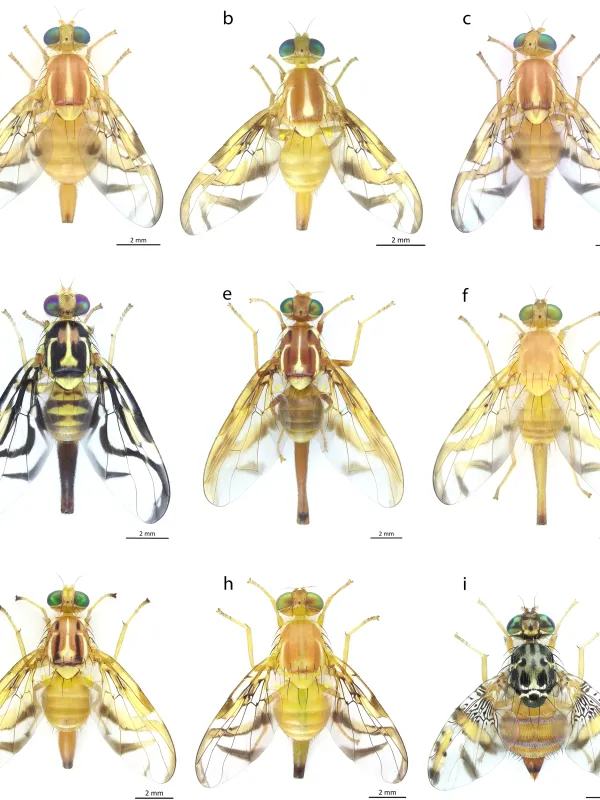
Anastrepha ornata is a member of the Tephritidae family, commonly known as fruit flies. It is a highly specialized insect that exhibits distinct morphological characteristics typical for the genus Anastrepha, particularly in its wing patterns.
Adult flies are generally small, typically ranging from 6 to 10 mm in length. Their bodies are predominantly yellowish-brown, and their wings feature characteristic dark, complex bands and spots that are essential for accurate taxonomical identification.
The female is equipped with a prominent ovipositor, an organ used to pierce the skin of ripening fruits. This anatomical feature allows the fly to deposit eggs safely inside the fruit, protecting them from environmental factors and predators.
Larvae are legless maggots with a creamy-white body that tapers towards the anterior end. As they feed and develop, they go through several larval instars within the fruit, significantly damaging the internal tissue.
Due to the close similarity between various species within the genus, definitive identification of Anastrepha ornata often requires examination of genitalia and wing venation by entomological experts under laboratory conditions.
What it damages
Anastrepha ornata acts as a severe polyphagous pest, capable of infesting a wide range of fruit crops. Its ability to feed on different hosts makes it a persistent threat to both local horticulture and international trade.
The primary economic damage is caused by larvae mining the pulp of the fruit. This feeding behavior turns the fruit flesh into a decayed, inedible mass, rendering it completely unsuitable for market consumption.
Fruits infested with Anastrepha ornata often exhibit premature ripening and drop from the tree. Those that remain on the branches are frequently affected by secondary fungal or bacterial infections that enter through the larval exit holes.
The presence of this pest in an orchard often results in strict quarantine measures, prohibiting the export of fruit from the affected region. This leads to substantial economic losses for agricultural producers.
If left unmanaged, the pest can devastate entire harvests, leading to losses of up to 80-90% in susceptible fruit varieties, especially in years when climatic conditions favor rapid population growth.
When it appears
The biological cycle of Anastrepha ornata is strictly regulated by environmental temperature and moisture levels. In tropical and subtropical regions, the insect can complete multiple generations within a single growing season.
The emergence of adults is synchronized with the ripening of host fruits. This is a critical period when producers must be highly vigilant, as the flies actively seek suitable hosts to begin the oviposition cycle.
Development from egg to adult comprises several stages: egg, larval instars, pupa, and adult. The pupal stage commonly occurs in the soil, providing the insect with a protected environment to survive less favorable conditions.
High temperatures significantly accelerate the larval development, leading to overlapping generations and a rapid increase in the total population density throughout the orchard.
Effective monitoring relies on the deployment of various traps, including food-based attractants and synthetic pheromones, which are placed in trees before the fruiting season to detect the first arrivals of adult flies.
Control measures
Management of Anastrepha ornata relies on an Integrated Pest Management (IPM) approach. This includes a combination of quarantine enforcement, cultural practices, and chemical or biological control methods.
Cultural practices are vital, emphasizing the removal and destruction of fallen or infested fruits. By disposing of these fruits, growers can destroy the larvae and pupae residing inside, effectively breaking the pest's reproductive cycle.
Chemical control usually involves the use of targeted insecticide bait sprays. These baits entice the flies to feed, allowing for precise application of pesticides that minimize the impact on beneficial insects and the environment.
Biological control, such as the release of parasitoid wasps (e.g., Braconidae), has shown promise in reducing fruit fly populations. These natural enemies attack the larvae, providing a sustainable way to suppress the pest.
- Regular orchard scouting and monitoring
- Immediate collection of fallen fruit
- Use of bait stations and traps
- Application of selective insecticides
- Strict adherence to regional quarantine protocols
Taxonomy
- Latin name
- Anastrepha ornata
- Order
- Diptera (flies)
- Family
- Tephritidae
- EPPO code
- ANSTOR
Discussion
No discussions yet — be the first.