
South American fruit fly
Anastrepha fraterculus
Description
How to identify
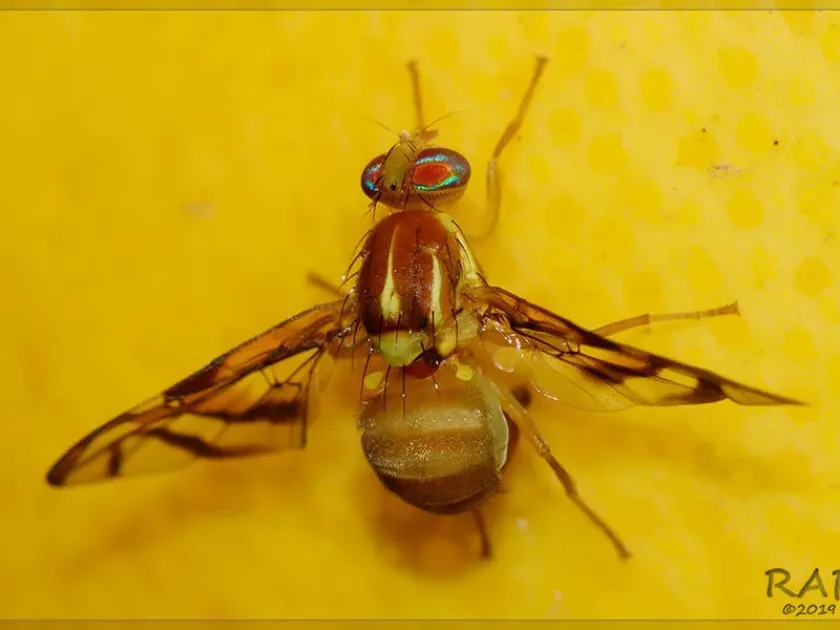
The South American fruit fly, Anastrepha fraterculus, is a significant member of the Tephritidae family. Adult flies are typically 6–8 mm long and exhibit a distinct yellowish-brown body with characteristic dark patterns on their wings.
Females possess a long, sharp ovipositor used to penetrate the skin of fruits and deposit eggs deep within the flesh. Males are generally smaller and lack this organ, focusing their activity on searching for mates.
Larvae are creamy-white, legless, and cylindrical, reaching about 10 mm at maturity. They undergo three distinct instar stages, growing rapidly as they consume the internal tissues of the host fruit.
Pupation occurs in the soil, where the insect forms a brown, barrel-shaped puparium. This stage is crucial for the survival of the species, as it provides protection against adverse environmental conditions.
Accurate identification of this species is complex due to its close resemblance to other Anastrepha species. Identification often requires expert entomological examination or molecular analysis of DNA markers.
What it damages
Anastrepha fraterculus is a highly destructive polyphagous pest capable of infesting a wide range of fruit crops. Its broad host range makes it a severe threat to both commercial and subsistence farming.
It predominantly attacks crops such as citrus, peaches, apples, pears, mangoes, and guavas. The list of host plants includes over 100 different species, highlighting its adaptability to diverse environments.
The primary damage is caused by the larvae feeding inside the fruit. This feeding creates internal tunnels, destroys the pulp, and leads to premature fruit drop and complete loss of marketability.
Feeding sites often become entry points for secondary pathogens, including fungi and bacteria. This leads to the rapid decay of the fruit, making it completely inedible and often causing rot to spread to neighboring fruits.
The economic impact is massive, involving significant crop losses, increased production costs due to pesticide application, and strict international quarantine regulations that limit trade opportunities.
When it appears
The life cycle of the South American fruit fly is closely linked to fruit maturation and local climate. A single generation can be completed in as little as 3 to 6 weeks under optimal conditions.
After eggs are laid, the incubation period is brief, typically lasting only a few days before larvae hatch. The larvae then feed inside the fruit for 2–3 weeks before exiting to reach the soil for pupation.
The pupal stage lasts between 10 to 15 days, after which adult flies emerge to start the cycle again. In tropical climates, reproduction continues throughout the year if host fruits are available.
Adult activity peaks during warm periods when temperatures range from 20°C to 28°C. These conditions are ideal for the fly to locate ripening fruit and engage in mass oviposition, leading to high infestation rates.
Because the flies can reproduce rapidly, a small initial population can expand into a major infestation within a few weeks, making seasonal monitoring essential for effective management.
Signs of infestation
The first indicator of infestation is the presence of small puncture marks on the fruit skin, known as oviposition stings. These often show as dark spots or tiny soft depressions as the tissue reacts.
Internally, the fruit shows clear signs of larvae infestation, such as irregular tunnels and galleries filled with frass and decaying tissue. The fruit may feel soft or appear water-soaked in affected areas.
Premature ripening or dropping of fruit is a common symptom. If you find fallen fruit, it is often a signal that mature larvae have already exited the fruit to pupate in the ground.
Monitoring using pheromone-baited or food-attractant traps is the most reliable way to detect the presence of adults. These traps capture flies, providing early warnings before the entire crop is compromised.
Deformation of the fruit, uneven coloring, and poor overall shelf life are other signs of infestation. In severe cases, the fruit may collapse entirely under the pressure of larval feeding.
Control measures
Effective management of Anastrepha fraterculus requires an Integrated Pest Management (IPM) approach that targets the life cycle at multiple stages to reduce the population effectively.
- Sanitation is vital: consistently collect and destroy fallen fruit to prevent larvae from entering the soil to pupate.
- Use mass trapping techniques with protein baits or specific attractants to reduce the population of adults in the orchard.
- Apply environmentally friendly insecticide sprays only when necessary, focusing on the adult stage to prevent egg-laying.
- Implement biological control by releasing parasitoid wasps that specifically target fruit fly larvae.
- Maintain strict biosecurity measures and adhere to quarantine protocols to prevent the transport of infested produce between regions.
Chemical control should be applied judiciously, ensuring that it does not disrupt local ecosystems or leave harmful residues on the harvest, adhering strictly to pre-harvest intervals.
Constant vigilance and monitoring are necessary for success. By tracking population trends through trap counts, farmers can time their interventions precisely for maximum impact with minimal chemical input.
Taxonomy
- Latin name
- Anastrepha fraterculus
- Order
- Diptera (flies)
- Family
- Tephritidae
- EPPO code
- ANSTFR
Discussion
No discussions yet — be the first.