
Papaya fruit fly
Anastrepha curvicauda
Description
How to identify
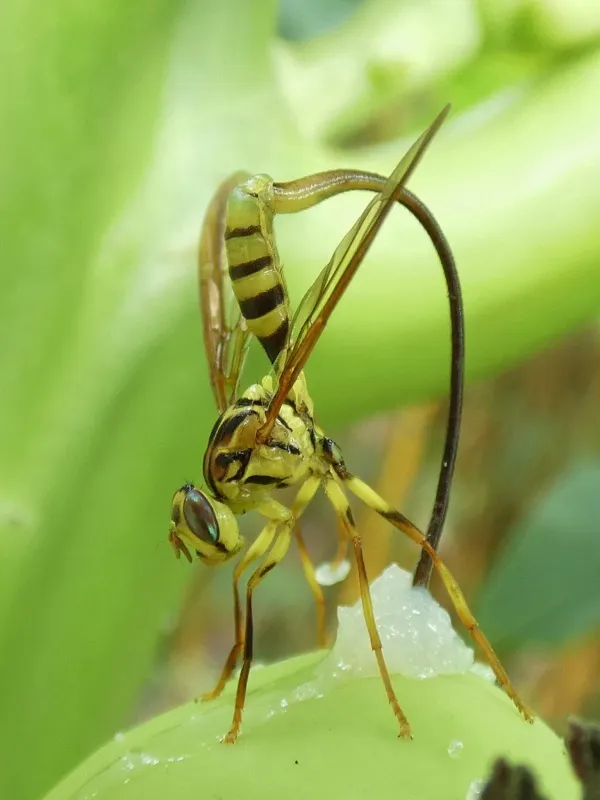
The Papaya fruit fly (Anastrepha curvicauda) belongs to the family Tephritidae, order Diptera. These flies are recognized by their distinct wing patterns and a yellowish-brown coloration typical of the genus.
The defining feature of the female is its extremely long, needle-like ovipositor. This biological adaptation is essential for penetrating the hard skin of developing papaya fruits to deposit eggs deep inside the mesocarp.
What it damages
The primary host for this pest is the papaya tree (Carica papaya). The larvae feed on the interior of the fruit, targeting both the developing seeds and the soft fruit tissues.
Economic damage is substantial, as infested fruits often undergo rapid decomposition. Even in early stages, the presence of internal larvae makes the fruit completely unsuitable for the fresh market or export.
When it appears
In tropical environments, breeding is continuous as long as host fruits are available. The life cycle comprises egg, three larval instars, pupa, and adult, with the pupal stage typically occurring in the soil beneath the host plant.
The population growth rate is highly sensitive to temperature and humidity levels. High ambient humidity often correlates with increased survival rates of larvae inside the protected environment of the fruit.
Signs of infestation
Symptoms of infestation include premature yellowing and dropping of young fruits. Visual inspection often reveals small puncture wounds on the fruit surface, frequently surrounded by necrotic tissue.
Internally, the fruit shows extensive tunneling and decay caused by larval feeding. Secondary infections by pathogens often follow, leading to a foul odor and total liquefaction of the fruit interior.
Control measures
Integrated Pest Management (IPM) is essential for effective control. The most critical practice is the consistent removal and destruction of all dropped or damaged fruits to break the life cycle by eliminating larval sources.
Mechanical protection, such as bagging individual fruits when they are young, remains the most reliable non-chemical method. Monitoring using specialized attractant traps is recommended to track population spikes and time potential interventions.
Taxonomy
- Latin name
- Anastrepha curvicauda
- Order
- Diptera (flies)
- Family
- Tephritidae
- EPPO code
- TOXTCU
Discussion
No discussions yet — be the first.