
Coconut mite
Amrineus coconuciferae
Description
How to identify
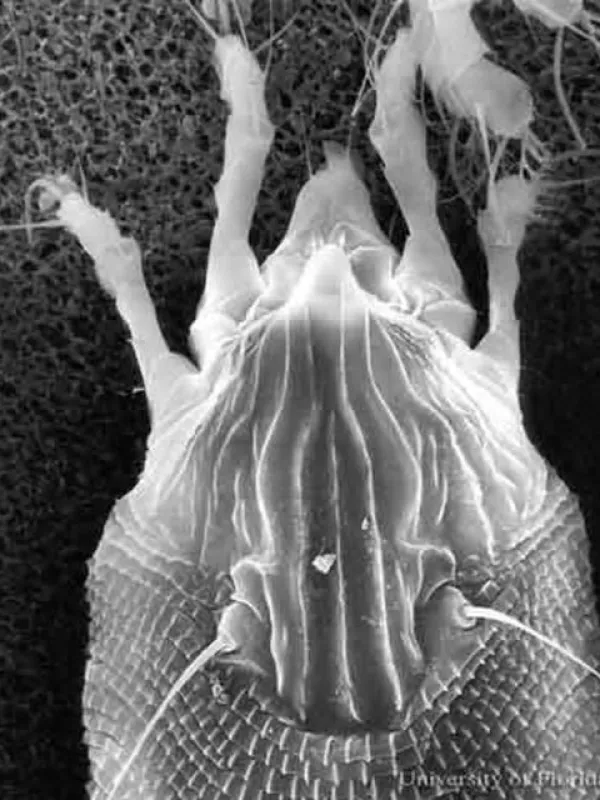
The coconut mite (Amrineus coconuciferae) is a microscopic pest belonging to the family Diptilomiopidae. It is an invasive eriophyid mite that has become a major threat to coconut production in various tropical countries.
Adult mites are extremely small, measuring only a few micrometers in length, with a spindle-shaped, worm-like body. Their pale, translucent appearance makes them nearly invisible to the naked eye on the surface of coconut fruits.
These mites primarily colonize the meristematic tissues under the bracts (sepals) of young coconut fruits. This protected environment allows them to feed and reproduce while remaining shielded from many environmental stressors.
Dispersal occurs mainly via wind currents, which carry the mites over large distances to new trees. Human-mediated spread through the movement of infested seedlings is also a significant factor in its global expansion.
The lifecycle is exceptionally rapid, with multiple generations occurring throughout the year, especially in regions with consistent high humidity and warm temperatures conducive to rapid population growth.
What it damages
The primary host for Amrineus coconuciferae is the coconut palm (Cocos nucifera). The mites cause damage by sucking sap from the developing nut, specifically targeting the area hidden by the perianth.
Feeding injury leads to the death of plant cells, causing the epidermis to crack as the fruit expands. This results in the formation of deep, necrotic fissures and a corky appearance on the nut's surface.
Severe infestations cause significant fruit deformation and reduction in size. This not only makes the nuts unsightly but also hinders their commercial value for market consumption and industrial processing.
Yield loss is the most critical impact of this pest, with total production potentially decreasing by up to 50% in untreated plantations. This poses a threat to food security and the livelihoods of coconut farmers.
Affected palms also suffer from reduced vitality, which can impact long-term tree productivity and increase susceptibility to other secondary fungal or bacterial pathogens infiltrating the damaged tissues.
Signs of infestation
The earliest signs of an infestation include the appearance of tiny, yellow-to-brown patches on the surface of young nuts located beneath the bracts. These spots often go unnoticed until the mite population explodes.
As the nut matures, the feeding damage manifests as distinct longitudinal cracks or a roughened, triangular-shaped necrotic area starting from the base of the fruit. This is a tell-tale sign of mite activity.
Massive premature shedding of small nuts is a frequent indicator of high pest pressure. Farmers often observe large quantities of aborted fruits under the canopy of infested palms.
The infestation can be verified by prying back the bracts of a suspicious fruit to reveal the characteristic accumulation of white, dust-like debris, which consists of dead mites, eggs, and molted skins.
- Yellowing patches near the nut base
- Development of corky, fissured tissue
- Deformed and stunted fruit growth
- Premature fruit drop (abscission)
Control measures
Integrated Pest Management (IPM) is essential for controlling the coconut mite. Relying solely on one method is rarely effective due to the cryptic nature of the pest under the bracts.
Chemical control often involves systemic acaricides applied via trunk injection. This method is highly effective as it delivers the pesticide directly into the palm's vascular system, ensuring the nuts are protected from within.
Cultural practices, such as removing and destroying heavily infested nuts and maintaining proper tree hygiene, are vital to reducing the local reservoir of mites within a plantation.
Biological control agents, particularly predatory phytoseiid mites, have shown potential in reducing coconut mite populations. Implementing conservation programs for these predators can provide long-term, sustainable suppression.
Regular monitoring of young nut bunches is crucial for early detection. Early action significantly reduces the risk of widespread infestation and minimizes the need for heavy chemical applications.
Taxonomy
- Latin name
- Amrineus coconuciferae
- Order
- Mites
- Family
- Eriophyidae
- EPPO code
- AMRICC
Discussion
No discussions yet — be the first.