
Banana spotting bug
Amblypelta lutescens
Description
How to identify
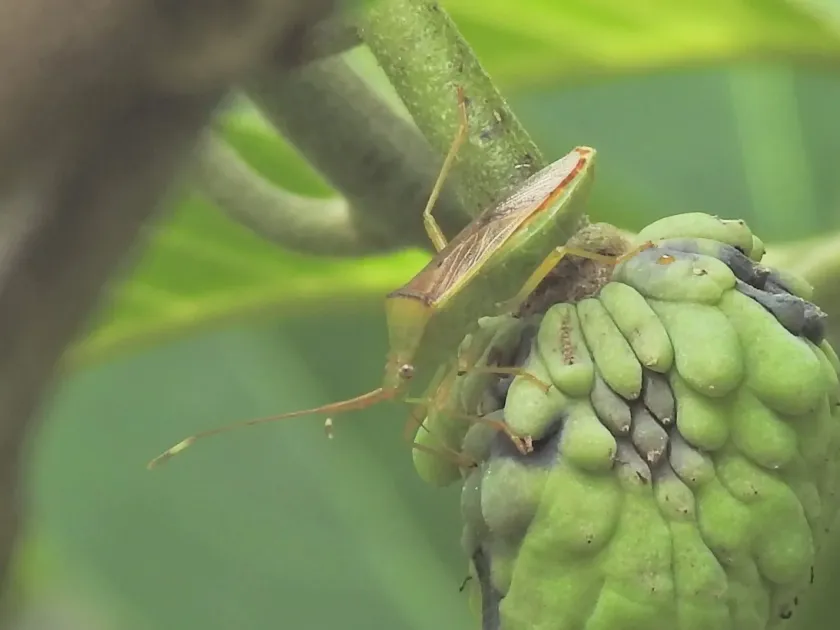
The banana spotting bug (Amblypelta lutescens) is a member of the Coreidae family, order Hemiptera. These insects are characterized by a slender body, measuring approximately 12 to 15 mm in length, and vary in color from pale green to brownish.
Adult bugs possess long antennae and well-developed wings, enabling efficient flight between host plants. Their mouthparts are designed for piercing and sucking, which allows them to extract nutrient-rich plant sap.
Nymphs undergo five stages of development. Throughout these stages, their appearance gradually transitions, with younger nymphs often displaying brighter, more distinctive warning colors compared to the adults.
The lifecycle is continuous in favorable tropical environments, allowing the population to breed throughout the year. The lack of seasonal dormancy makes this pest particularly difficult to manage.
As a significant pest in regions like Australia, it targets various tropical crops, leading to severe economic losses in the commercial fruit industry.
What it damages
Both adults and nymphs cause damage by feeding on young fruit, shoots, and developing flower buds. During feeding, they inject toxic saliva into the plant tissues.
This saliva contains enzymes that cause localized necrosis, leading to tissue death. In bananas, this results in the development of blackened, depressed lesions on the skin, causing severe fruit deformity.
The damage often renders the fruit unmarketable for both domestic consumption and export. Furthermore, the lesions act as entry points for secondary fungal and bacterial pathogens.
Infestations can cause premature fruit drop and stunt the growth of young banana plants. Chronic feeding leads to a loss of vigor and potential reduction in total plantation yield.
Due to its polyphagous nature, the bug can move between different hosts, such as mango, avocado, and macadamia, maintaining high pressure on agricultural ecosystems.
When it appears
Activity patterns are strongly correlated with temperature and humidity levels. Development is fastest during warmer months when ambient conditions are optimal for reproduction.
Multiple overlapping generations occur annually in tropical settings. Migration peaks typically align with the flowering and fruit-set phases of the target crops.
The bugs are most active during the cooler parts of the day, specifically in the early morning or late afternoon, when they move onto the upper foliage to feed.
Sheltered microclimates within dense canopy plantations provide ideal conditions for the survival and multiplication of the species throughout the year.
Overwintering (or over-seasoning) adults typically hide in surrounding weeds, hedges, or crop debris, making field sanitation a critical component of population management.
Signs of infestation
Early identification of the banana spotting bug can be difficult. The first visible symptoms are small, dark, water-soaked spots on the surface of young fruits.
Over time, these spots darken and become sunken as the necrotic tissue dries out. Splitting of the banana skin is a common indicator of severe damage caused by earlier feeding.
Shoot tips and young leaves may show signs of wilting or dieback due to heavy feeding pressure on the growing points of the plant.
Physical inspection of the banana bunch or leaf undersides often reveals the presence of nymphs or adults resting or feeding in clusters.
Widespread leaf yellowing and stunted fruit growth within a specific patch of the orchard are strong indications of an active infestation that requires intervention.
Control measures
Effective management requires an integrated approach to reduce population density and protect the commercial yield of the crop.
- Maintain strict weed control within and around the plantation to remove alternative hosts for the bugs.
- Monitor population levels using pheromone-baited traps to identify critical treatment windows.
- Apply systemic insecticides targeting the nymphs and adults when threshold levels are exceeded.
- Encourage biological control agents, such as parasitoid wasps, which prey on the eggs of the bug.
- Practice regular orchard hygiene by removing and destroying severely damaged fruit or shoots to prevent pathogen spread.
Taxonomy
- Latin name
- Amblypelta lutescens
- Order
- Hemiptera (bugs, aphids, leafhoppers)
- Family
- Coreidae
- EPPO code
- AMBPLU
Discussion
No discussions yet — be the first.