
Vagabond crambus
Agriphila vulgivagella
Description
How to identify
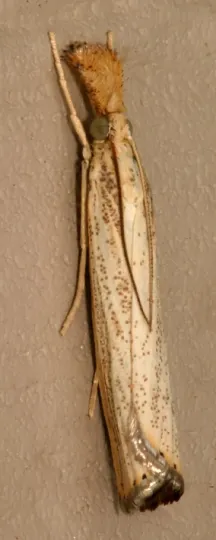
Agriphila vulgivagella, commonly known as the vagabond crambus, is a species of moth in the family Crambidae. The adult moth has a wingspan of approximately 20–25 mm, with ochre-yellow forewings featuring a distinct white longitudinal stripe and dark markings along the margins.
The larvae, or caterpillars, reach lengths of up to 20 mm. They are typically dirty white or yellowish-grey, covered in sparse hairs, with a dark brown or black head capsule. Their bodies are often marked with small, dark, raised spots.
This species undergoes a complete metamorphosis: egg, larva, pupa, and adult. In most regions, it completes one generation per year, though environmental conditions may influence the timing of emergence.
Larvae overwinter in the soil or within dense silken cocoons nestled among plant debris, providing them with protection against cold temperatures and environmental stress.
Pupation occurs in the spring within underground cells. After emergence, the adults are nocturnal, showing high activity during dusk and nighttime hours, which is when they typically lay eggs on host grasses.
What it damages
The primary hosts for this pest include various cereal crops such as wheat, barley, oats, and corn, as well as several species of wild grasses found in pastures and field margins.
The larvae are responsible for the damage, as they feed on the root systems and the base of the stems immediately after they emerge from dormancy in the spring.
Young larvae initially graze on leaf surfaces, while older larvae cut through the stems at the soil surface, causing the entire plant to wilt and die prematurely.
The most critical damage occurs during the tillering stage of cereal growth, where the destruction of central shoots can lead to significant gaps in plant density and reduced crop yields.
Heavy infestations can devastate large patches of a field, significantly impacting the uniformity and overall productivity of the crop.
Signs of infestation
The primary symptom of infestation is the appearance of stunted or yellowish patches in the field, where plants begin to wilt and collapse without apparent water stress.
Upon closer inspection of damaged plants, one can observe feeding marks on the foliage and find larvae or their silken webs near the base of the stem within the upper soil layer.
Monitoring for adults during the flight period is essential; their presence in the field at dusk serves as an early warning for potential larval activity.
Small, granular dark excrement scattered around the base of the plants is a distinct sign of larval feeding activity occurring in the immediate vicinity.
Plants affected by stem-boring or cutting at the base often lean over or detach easily when pulled, indicating the severance of the main vascular system near the crown.
Control measures
Effective management begins with cultural practices, such as deep autumn tillage, which disrupts the overwintering sites of the larvae and exposes them to predators and cold.
Implementing a robust crop rotation strategy is vital to avoid host-crop succession, which helps prevent the build-up of larval populations in specific field areas.
Chemical control involving insecticides is warranted when larval populations exceed established economic thresholds, particularly in high-density cereal stands.
- Treating seeds with appropriate insecticidal coatings.
- Maintaining field hygiene by eliminating grassy weeds that serve as alternate hosts.
- Deploying pheromone traps to monitor adult flight and inform application timing.
Regular field scouting during the early growth stages is necessary to identify hotspots early, allowing for localized treatments rather than whole-field applications.
Taxonomy
- Latin name
- Agriphila vulgivagella
- Order
- Lepidoptera (butterflies)
- Family
- Crambidae
- EPPO code
- CRAMVU
Discussion
No discussions yet — be the first.