
Agriphila
Agriphila
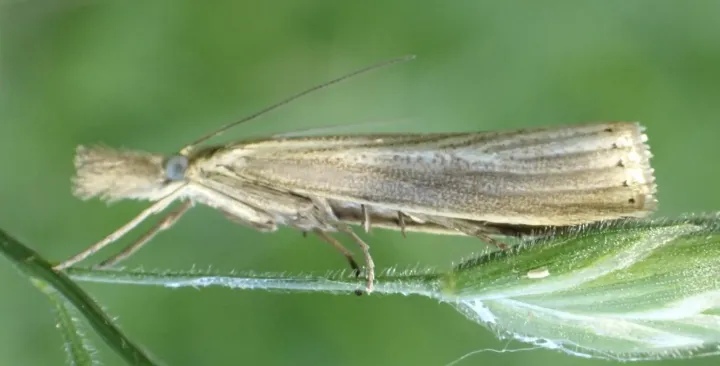
Description
How to identify
The genus Agriphila belongs to the family Crambidae, commonly known as grass moths. These moths are characterized by their resting position, where wings are wrapped tightly around the body.
The coloration of these moths typically features straw-yellow, brown, or grey tones with silvery streaks, providing excellent camouflage against dry grass stems.
The larvae are typical of the family, usually appearing dirty white or greyish, often with visible dark spots and a robust, dark-colored head capsule.
Adult moths are nocturnal or crepuscular, spending the daylight hours concealed within dense vegetation or plant debris at the soil surface.
Accurate species identification within this genus often requires microscopic examination of the genitalia, as wing patterns can be highly variable and similar across related species.
What it damages
Agriphila larvae are polyphagous, but they show a strong preference for members of the Poaceae family, commonly known as grasses.
They are known pests of cereals such as wheat, rye, barley, and oats, causing significant damage to both commercial fields and pasture lands.
Damage often starts near the field edges or in areas adjacent to uncultivated land, where the moths find suitable conditions for egg-laying.
Larvae feed by boring into the stems near the base or cutting off the stems entirely, which disrupts the vascular transport in the plant.
Severe infestations can lead to substantial thinning of the crop stand, reducing the overall plant population and potential yield significantly.
When it appears
Adults are typically active during the summer months, with flight periods generally occurring between June and August depending on the latitude.
Females lay their eggs on or near the stems of host plants and in the upper layers of the soil, ensuring the larvae have immediate access to food.
The species survives the winter as larvae, which go into a state of dormancy in the soil or protected crevices during the cold season.
In the spring, as soil temperatures rise, the larvae resume feeding, targeting the young and tender shoots of early-season crops.
Pupation takes place in the soil within protective chambers, from which the next generation of adults emerges during the following summer.
Signs of infestation
The most prominent sign of infestation is the yellowing and wilting of the central shoot, often called "deadheart," which occurs even if the roots are intact.
Close inspection of the stem base reveals feeding holes or ragged edges, often accompanied by frass (larval waste) scattered around the entry point.
In some cases, the larvae create silken tubes or galleries reinforced with soil particles, which serve as their protective retreats during the day.
Affected fields may show patchy growth, with clusters of withered plants appearing as the larvae migrate from their initial feeding sites.
- Deadheart symptom in cereal plants.
- Silken galleries at the base of the stem.
- Frass deposits near the feeding site.
Control measures
Effective agricultural management starts with deep autumn ploughing, which disturbs the soil and exposes overwintering larvae to predators and frost.
Sanitation practices, including the removal of weeds and crop residues, are essential to eliminate the habitats where the moths breed.
Crop rotation should be strictly implemented to avoid planting cereals in succession on the same plots, which helps prevent pest population build-up.
Chemical control involving systemic insecticides is recommended if monitoring indicates that the larval density exceeds the economic injury level.
Using light traps or pheromone monitoring during the flight season helps producers identify the peak adult activity for timely intervention.
Taxonomy
- Latin name
- Agriphila
- Order
- Lepidoptera (butterflies)
- Family
- Crambidae
- EPPO code
- AGPHSP
Discussion
No discussions yet — be the first.