
Aetalion
Aetalion
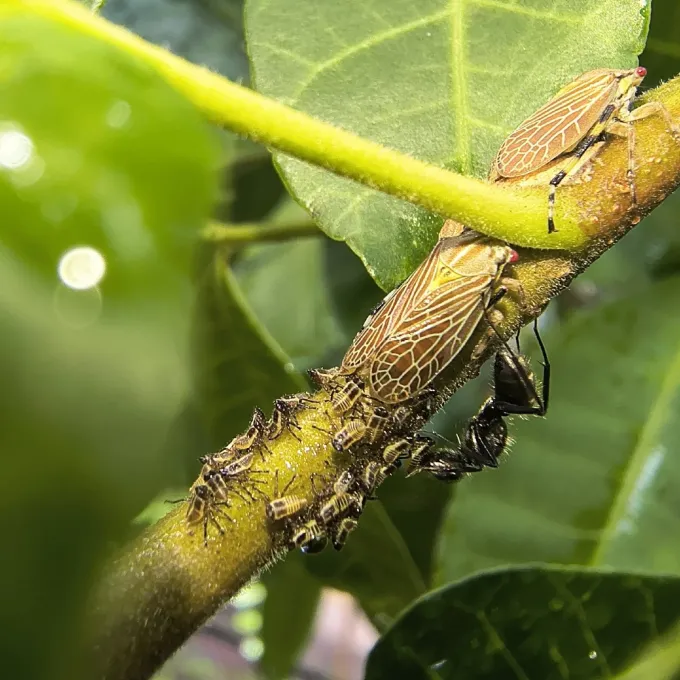
Description
How to identify
The genus Aetalion belongs to the family Aetalionidae, within the order Hemiptera. These insects are known for their distinct morphological features, which include a robust body structure and specialized mouthparts for sap-feeding.
Adult insects often display a cryptic coloration that allows them to blend in with the bark of host trees, making them difficult to detect without careful inspection.
A unique aspect of their biology is their obligatory mutualism with ants, which protect the nymphs and adults from predators in exchange for the honeydew the pests excrete.
The life cycle encompasses eggs, several nymphal instars, and the adult stage, with females typically laying eggs in clustered groups directly into the plant tissue.
This group is endemic primarily to the Neotropical regions, where it occupies specific ecological niches within diverse forest and agricultural ecosystems.
What it damages
Aetalion poses a threat to various commercial crops, including citrus, cocoa, and avocado, by directly feeding on the sap of young and tender plant parts.
The sustained feeding activity of large colonies leads to significant physiological stress in trees, often resulting in reduced growth, vigor, and potential crop yield loss.
In addition to direct damage, the honeydew excreted by the pests serves as a substrate for sooty mold growth, which covers leaves and hinders the process of photosynthesis.
Frequent punctures in the bark, made by the insect's proboscis, can disrupt the plant's vascular transport system, leading to necrosis and weakening of the branches.
In severe infestations, the cumulative effect of tissue damage and secondary infections can lead to branch dieback and diminished overall tree health.
When it appears
The seasonal activity of Aetalion is largely governed by climatic factors, with populations often peaking during warm, humid periods when plant growth is most vigorous.
In tropical environments, the pest can remain active year-round, provided that there is a steady supply of fresh plant material to support egg-laying and development.
Dispersal to new host plants typically occurs during favorable weather conditions when adults migrate to establish new colonies on healthier branches.
Populations tend to stabilize or decline in the absence of suitable host plant phenological stages or when natural enemies increase in density.
Agronomic monitoring is most effective during periods of flush growth, as these are the primary sites where the insects congregate to feed and reproduce.
Signs of infestation
The most reliable indicator of an Aetalion infestation is the presence of ant trails leading to clustered insect colonies located on branches or twigs.
The accumulation of sticky honeydew on the bark, often followed by the development of black sooty mold, provides a visual alert for the presence of the pests.
Deformation of young shoots, such as twisting or stunted development, often occurs in areas where large colonies have been feeding for an extended period.
Small, necrotic spots on the bark, marking the sites of feeding punctures, are common symptoms that can be observed upon close examination of the plant.
The presence of white, shed nymphal skins attached to the bark is a clear sign that the pest has successfully completed one or more developmental stages at that site.
Control measures
Effective management begins with disrupting the ant-pest mutualism, which reduces the survival rate of the nymphs by exposing them to natural predators.
Chemical control involving the use of systemic or contact insecticides is often necessary in commercial plantations to suppress high-density populations.
Cultural practices, such as judicious pruning of infested branches, play a critical role in reducing the pest population and preventing its spread to healthy parts of the crop.
Integrated Pest Management (IPM) programs should incorporate biological control agents, including parasitic wasps, which can help maintain Aetalion levels below economic thresholds.
- Application of insecticide sprays with surfactants for better coverage.
- Use of adhesive barriers on tree trunks to block ant access.
- Removal and destruction of highly infested plant debris.
- Regular inspection and monitoring during the growth season.
Taxonomy
- Latin name
- Aetalion
- Order
- Hemiptera (bugs, aphids, leafhoppers)
- Family
- Membracidae
- EPPO code
- AETHSP
Discussion
No discussions yet — be the first.