
Aedia
Aedia
Description
How to identify
Aedia is a genus of moths belonging to the family Erebidae, within the order Lepidoptera. The most prominent agricultural species is Aedia leucomelas, often referred to as the sweet potato moth or spotty moth.
The adult moth has a wingspan of approximately 35–40 mm. Its forewings exhibit mottled shades of grey and brown, providing excellent camouflage against tree bark and leaf litter, which helps them remain undetected.
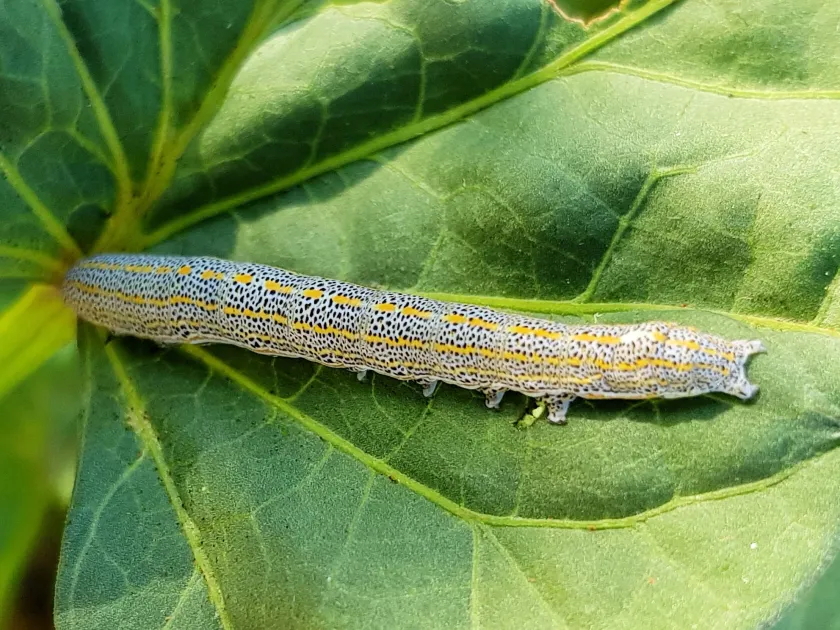
The larvae are typical of the noctuid family, featuring a segmented body with prolegs that facilitate movement across plant stems. Their coloration ranges from light green to brownish, adapting to the vegetation they consume.
The life cycle encompasses a complete metamorphosis: egg, larva, pupa, and imago. They generally overwinter as pupae buried in the soil or protected within plant debris.
Adult moths are primarily nocturnal, making them difficult to monitor without the use of light traps, which attract them during their flight periods.
What it damages
The primary host plant for Aedia larvae is the field bindweed (Convolvulus arvensis). However, during population outbreaks, they can migrate to various agricultural crops.
Crops such as sweet potatoes, legumes, and certain vegetables are particularly vulnerable to infestation if they are located near wild bindweed populations.
The larvae are voracious feeders, consuming leaf tissue from the edges or creating large, irregular holes throughout the leaf surface.
In cases of heavy infestation, the larvae can cause severe defoliation, which drastically reduces the plant's photosynthetic capacity and hinders the development of tubers or fruits.
Damage is most critical during the active growth stages of the crop, as the loss of leaf area directly correlates with decreased yield quality and quantity.
When it appears
The flight season of the adults typically begins in late spring and persists throughout the summer, heavily influenced by regional climate conditions.
The first generation of larvae emerges in early summer, feeding actively during June and July before entering the pupation phase.
In warmer southern regions, Aedia can complete multiple generations per year, posing a sustained threat to agriculture throughout the growing season.
Peak pest pressure on fields is usually observed in the second half of summer when conditions are optimal for larval development and rapid population growth.
Monitoring the field during the evening hours is recommended, as this is when larval feeding activity reaches its highest point.
Signs of infestation
The initial sign of an Aedia infestation is the presence of distinct, ragged feeding patterns along the leaf margins, which are characteristic of this species.
Frass (larval droppings), which appear as small dark pellets on the leaves, serve as an immediate indicator of active feeding in the surrounding area.
Careful inspection of the lower leaf surface may reveal small egg clusters, which are strategically placed by the female moth to protect them from direct sunlight.
Severe infestations manifest as general plant stress, stunted growth, and visible wilting of the affected foliage and stems.
- Larvae found on the undersides of leaves.
- Irregular, jagged holes in the foliage.
- Visible frass deposits on the leaves.
- Delayed development and poor vigor of host plants.
Control measures
Cultural control is the most effective preventative strategy, specifically the removal and management of field bindweed, which acts as the primary reservoir for the pest.
Deep autumn tillage (plowing) is recommended to disturb the soil and expose overwintering pupae to cold temperatures and natural predators, reducing the initial spring population.
Chemical control should be implemented using selective insecticides that are registered for use on the specific crop, strictly following the manufacturer’s application guidelines.
Biological control methods, such as the application of Bacillus thuringiensis, offer an eco-friendly alternative for managing larval populations without harming beneficial insects.
Integrating crop rotation and weed management with regular field scouting ensures that Aedia populations are kept well below economic injury levels.
Taxonomy
- Latin name
- Aedia
- Order
- Lepidoptera (butterflies)
- Family
- Erebidae
- EPPO code
- AEDISP
Discussion
No discussions yet — be the first.