
Willow gall mite
Aculus tetanothrix
Description
How to identify
The willow gall mite (Aculus tetanothrix) is a microscopic pest belonging to the Eriophyidae family. These mites are extremely small, with adults reaching only about 0.2 mm in length, making them invisible to the naked eye.
Morphologically, they are characterized by an elongated, vermiform body with only two pairs of legs situated at the anterior end. Their color typically ranges from pale yellow to whitish, which allows them to blend in with leaf tissues.
The mite follows a precise life cycle synchronized with the phenology of its host plant, the willow. Fertilized females overwinter in protected sites such as bud scales, bark crevices, or twig junctions.
Spring warming triggers the reactivation of these mites. They migrate to developing leaves to feed and lay eggs, initiating the development of the next generations and the formation of characteristic galls.
Dispersal is primarily passive, relying on wind, rain splashes, or accidental transport via garden tools or infested planting material, which facilitates rapid colonization of adjacent trees.
What it damages
Willow gall mites are highly host-specific, exclusively attacking various species of willow (Salix). Both native and ornamental willow varieties are susceptible to infestations.
The damage is caused by the mite's piercing-sucking mouthparts. As they feed on leaf sap, they induce the plant to produce chemical signals that result in abnormal tissue growth, known as galls.
These galls serve as both a food source and a protective shelter for the mite colony. However, they cause significant physiological stress to the tree by disrupting water and nutrient transport in the leaf lamina.
Severe infestations lead to stunted leaf growth, premature leaf yellowing, and eventual abscission. For ornamental varieties, this significantly reduces the aesthetic value of the tree.
While mature, vigorous trees usually tolerate these infestations without lethal consequences, young saplings can suffer from reduced growth rates and compromised vigor over multiple seasons.
Signs of infestation
The first signs of infestation become apparent in late spring as young leaves emerge. Initial symptoms appear as small, subtle bumps or discolorations on the leaf surface.
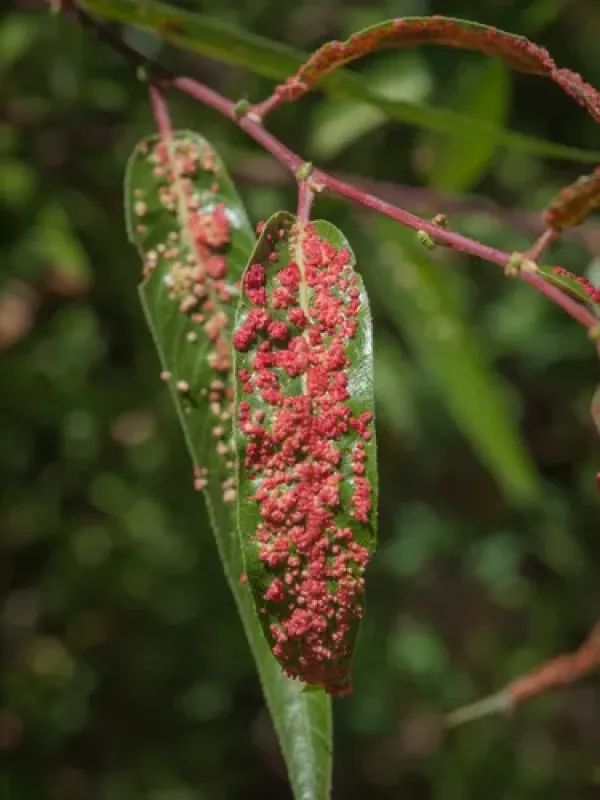
The most distinctive diagnostic feature is the presence of galls. These can appear as small, conical projections, finger-like structures, or dense, cushion-like clusters, often colored in shades of red, pink, or green.
Infested leaves often exhibit varying degrees of curling and distortion. The tissue within the galls may become corky or necrotic as the season progresses, turning brown or black.
In cases of high pest pressure, the foliage may look heavily deformed or "bumpy." This visual symptom is often the first indicator that homeowners notice when inspecting their gardens.
Checking the underside of leaves for these malformations is key, as many gall-forming species localize their colonies in specific parts of the leaf structure depending on the mite species.
Control measures
Controlling the willow gall mite is challenging because the mites are protected inside the galls, where most contact insecticides cannot reach them effectively.
The most recommended practice is the systematic removal and destruction of heavily infested twigs. Pruning prevents the mites from moving to healthy foliage and limits next year's population.
Chemical intervention should be timed carefully. Applications are most effective during the early spring bud-burst phase when overwintering females emerge before they create the protective galls.
Systemic acaricides are preferred as they can move through the plant's vascular system, reaching the mites even within established galls or protected bud crevices.
- Perform regular inspections during the spring months;
- Prune and incinerate affected branches;
- Apply systemic acaricides during early bud development;
- Maintain tree vigor through proper watering and fertilization.
Taxonomy
- Latin name
- Aculus tetanothrix
- Order
- Mites
- Family
- Eriophyidae
- EPPO code
- ACULTE
Discussion
No discussions yet — be the first.