
Plum rust mite
Aculus fockeui
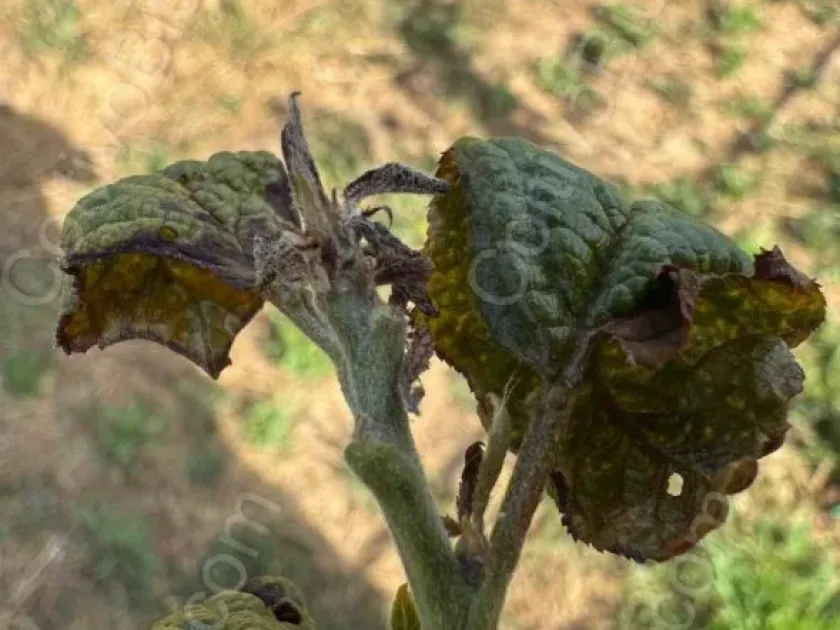
Description
How to identify
The plum rust mite (Aculus fockeui) is a microscopic pest belonging to the family Eriophyidae, order Acariformes. These mites are extremely small, typically measuring between 0.15 and 0.2 mm, making them nearly invisible to the naked eye.
They possess an elongated, spindle-shaped body, which is usually cream or yellow-white in color, and feature only two pairs of legs located near the head region.
Plum rust mites thrive in warm conditions, which accelerate their life cycle, allowing them to produce multiple overlapping generations throughout the growing season.
Overwintering females find refuge in bark crevices, under bud scales, or at the base of buds, where they remain dormant until the favorable spring temperatures trigger their migration.
As soon as growth begins, they move onto the expanding foliage, where they begin to feed and establish their colonies on the undersides of the leaves.
What it damages
This mite primarily attacks stone fruit trees, with plum and damson being the most common hosts, although it frequently affects cherry, peach, and apricot trees as well.
Damage is caused by the mite’s feeding activity, where they puncture leaf cells to suck out plant sap, leading to localized plant tissue reactions.
This feeding disrupts the plant's metabolic processes and photosynthesis, causing the leaves to become stunted, deformed, and chlorotic.
Heavy infestations lead to early leaf drop, which can significantly reduce the tree's vigor and weaken its ability to survive winter or develop fruit for the following year.
Prolonged damage negatively impacts fruit set and quality, causing economic losses in both commercial orchards and backyard gardens.
Signs of infestation
The most distinctive sign of infestation is the formation of galls — abnormal swelling of plant tissue caused by the mite's salivary secretions during feeding.
These galls often appear as small, bumpy, or raised patches on the leaf surface, which may change from green to reddish, brown, or black as they age.
Leaf curling, twisting, or a distorted, crinkled appearance is common, making the foliage look unhealthy and severely impacted by abiotic or biotic stress.
A fine, dusty, or whitish coating may be visible on the underside of infested leaves under magnification, representing dense populations of the mites.
In severe cases, entire branches may show stunted growth and premature yellowing, which often alerts growers to the presence of the pest.
Control measures
Managing the plum rust mite is difficult because the mites are protected within the galls they create, making direct contact with chemical sprays less effective once symptoms appear.
The most critical window for control occurs in early spring, just as the buds begin to swell and open, when overwintering mites emerge to colonize the fresh leaves.
- Application of specialized acaricides effective against Eriophyid mites.
- Pruning and destroying heavily infested branches to reduce the pest population during the season.
- Using sulfur-based sprays during the dormant or early spring period as a preventive measure.
- Promoting healthy tree growth through balanced fertilization and proper irrigation.
- Monitoring foliage frequently for the first signs of leaf distortion to time applications accurately.
Integrated pest management (IPM) practices should be employed, alternating between different classes of pesticides to minimize the risk of developing resistance.
It is essential to ensure thorough coverage of the trees, particularly the undersides of the leaves, when applying control agents to achieve maximum efficacy.
Taxonomy
- Latin name
- Aculus fockeui
- Order
- Mites
- Family
- Eriophyidae
- EPPO code
- VASAFL
Discussion
No discussions yet — be the first.