
Tomato russet mite
Aculops lycopersici
Description
How to identify
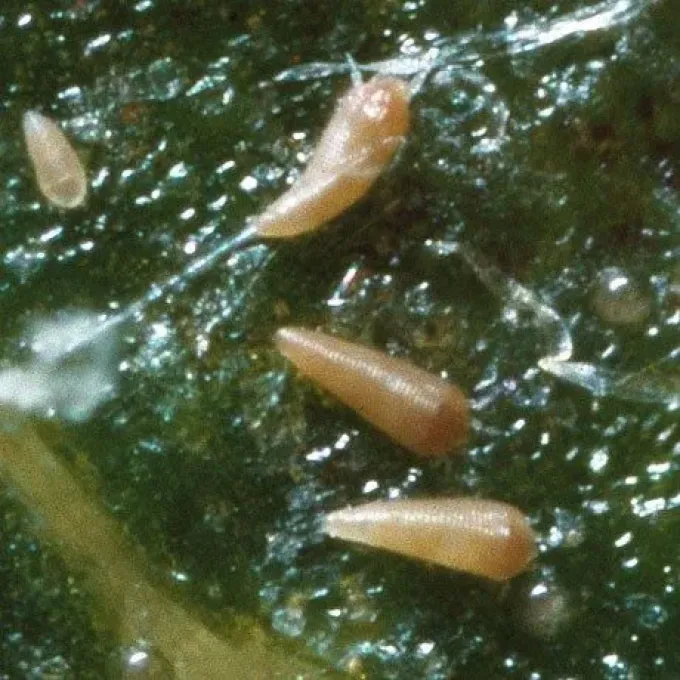
The tomato russet mite (Aculops lycopersici) is a microscopic pest belonging to the Eriophyidae family. Measuring only 0.15–0.25 mm in length, these mites are invisible to the naked eye and require magnification for accurate identification.
They possess a wedge-shaped body that ranges in color from yellow to pale pink. Unlike spider mites, they do not produce webbing, which often leads to late detection of the infestation.
The life cycle is remarkably rapid, completing from egg to adult in approximately 7 to 10 days, allowing for exponential population growth in short periods.
High temperatures (25–30 °C) and low humidity levels are the primary drivers of rapid mite reproduction, making greenhouses an ideal environment for their proliferation.
These mites are easily spread via wind currents, clothing, garden tools, or contaminated plant material, quickly colonizing new host plants.
What it damages
The primary host plants for this mite are members of the Solanaceae family, predominantly tomatoes, though they can also infest eggplants, peppers, and potatoes.
Mites feed on the epidermal cells of leaves and stems by injecting toxic saliva, which leads to tissue deformation and cell death.
The pest poses a significant threat to both greenhouse and field-grown crops, potentially causing widespread damage in commercial agricultural settings.
If left unmanaged, the population can destroy a major portion of the crop by inducing premature senescence and plant death.
Severe infestations effectively stop plant growth and cause blossom and fruit drop, rendering the plants unproductive and aesthetically ruined.
Signs of infestation
The first symptoms of an infestation are discoloration on the lower stems and leaves, which develop a characteristic "rusty" or bronze-colored appearance.
Leaves begin to curl upward, become brittle, and eventually dry out and die, progressing from the bottom of the plant toward the top.
On the fruit, damage manifests as a network of cork-like russeting on the skin, which becomes rough, brown, and prone to cracking, destroying marketability.
The stems may appear bare and develop a glossy, metallic bronze finish, which indicates a critical level of mite density.
- Bronze-colored patches on stems and leaves;
- Upward curling of leaf margins;
- Loss of turgor followed by desiccation of foliage;
- Corking and russeting on the fruit surface;
- Stunted growth and overall plant collapse.
Control measures
Preventive measures are crucial, including strict greenhouse sanitation, the removal of all weeds, and the destruction of post-harvest crop residues.
Ensuring the use of certified, clean plant material and enforcing quarantine protocols for new plants significantly reduces the risk of initial mite introduction.
Chemical control involves the application of registered acaricides, which should be used in rotation to prevent the development of resistance.
Regular applications, spaced 5–7 days apart, are necessary to effectively eliminate successive generations of mites as they hatch from eggs.
Biological control options, such as releasing predatory mites like Amblyseius or Phytoseiulus species, are highly effective in maintaining mite populations below the economic injury level.
Taxonomy
- Latin name
- Aculops lycopersici
- Order
- Mites
- Family
- Eriophyidae
- EPPO code
- VASALY
Discussion
No discussions yet — be the first.