
Fuchsia gall mite
Aculops fuchsiae
Description
How to identify
The fuchsia gall mite (Aculops fuchsiae) is a member of the Prostigmata order and the Eriophyidae family. These are microscopic mites, measuring less than 0.2 mm, making them invisible to the naked eye.
They have a worm-like, elongated body, typically translucent or yellowish. They spend their entire life cycle hidden within the plant tissues, specifically within the galls they induce the plant to create.
Because they are so small and concealed, detection is usually delayed until significant physical damage to the plant occurs. They are typically brought into a collection via infected cuttings or nursery stock.
Dispersal can occur through wind currents, insect vectors, or simply by touching infected and healthy plants. They thrive in warm, humid conditions which accelerate their life cycle and population growth.
This mite is highly host-specific, primarily attacking various species and hybrids of the genus Fuchsia. It is a major nuisance in both greenhouse production and home gardening.
What it damages
The fuchsia gall mite targets the actively growing parts of the fuchsia plant, including young leaves, shoot tips, and developing flower buds.
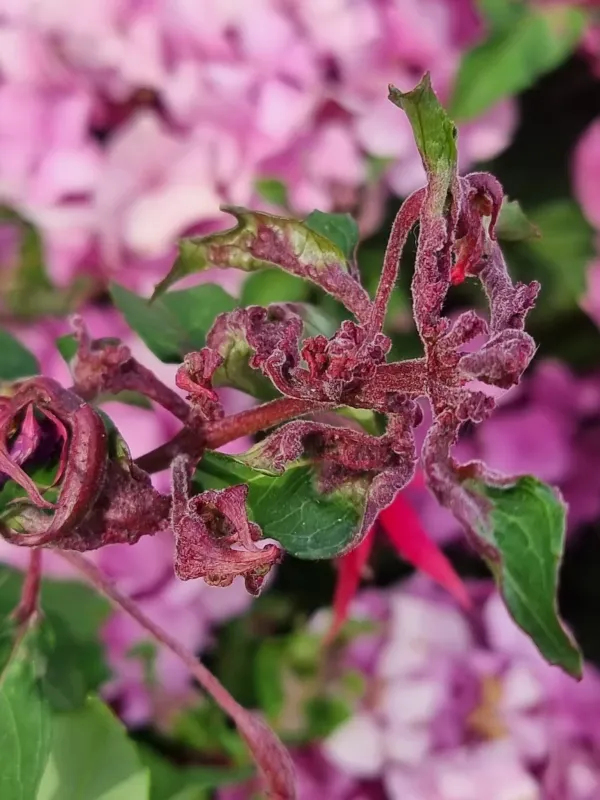
As the mites feed, they secrete enzymes that cause the plant to produce abnormal, rapid cell growth, resulting in galls. These galls can manifest as thickened, hairy, or convoluted tissue growths.
Affected leaves lose their ability to photosynthesize effectively, become twisted, and lose their natural shape. The development of buds is disrupted, causing the plant to stop blooming entirely.
Heavy infestations lead to stunted growth, where the internodes are significantly shortened. The overall architecture of the plant is ruined, and it may eventually lose all vigor.
The damaged tissue provides an ideal environment for secondary pathogens such as fungi and bacteria, which can further weaken or kill the host plant.
Signs of infestation
The first sign of infestation is typically the reddening or puckering of the youngest leaves at the shoot tips. These leaves often appear thick and distorted.
Close inspection reveals fuzzy, felt-like, or bumpy growths on the undersides of leaves or along the stem. These galls are the hallmark symptom of an Aculops fuchsiae attack.
The shoots themselves may become distorted and bunched, creating a "witches' broom" appearance. The normal elongation of the stem stops, making the plant look compact and unhealthy.
A sudden failure of a fuchsia to flower is often a warning sign. If the flower buds look deformed or fail to open, the plant should be closely inspected for mites.
Confirmation usually requires a microscope, as the mites themselves cannot be identified by superficial inspection, only by the distinct pathology they leave behind.
Control measures
Controlling fuchsia gall mite is notoriously difficult because the mites are protected inside the gall tissue, shielded from standard contact insecticides.
The most reliable control method is the physical removal and destruction of all infested plant parts. In severe cases, the entire plant should be disposed of to prevent spread.
Systemic acaricides are the preferred chemical treatment, though complete eradication is rarely achieved once the mite is established. Regular, consistent application is necessary.
- Quarantine all new plants before introducing them to your collection.
- Practice strict hygiene; sterilize tools between each plant.
- Avoid overhead watering to reduce the risk of spreading mites via water splashes.
- Monitor your plants frequently for any signs of leaf curling or abnormal growth.
Since total eradication is challenging, prevention through careful screening of new plant material is the most important management strategy for every fuchsia grower.
Taxonomy
- Latin name
- Aculops fuchsiae
- Order
- Mites
- Family
- Eriophyidae
- EPPO code
- ACUPFU
Discussion
No discussions yet — be the first.