
Fig mite
Aculops caricae
Description
How to identify
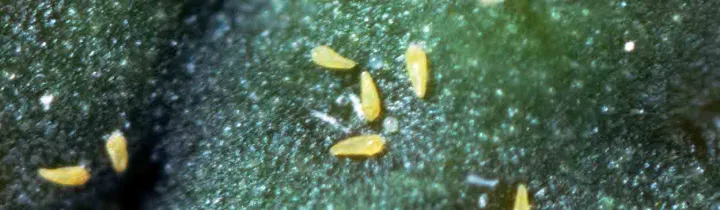
The fig mite (lat. Aculops caricae) belongs to the Eriophyidae family, order Acariformes. It is a microscopic pest that cannot be seen with the naked eye due to its extremely small size, reaching only about 0.15–0.2 mm in length.
The mite has an elongated, worm-like body that is translucent or yellowish-white in color. It possesses only two pairs of legs located at the front of the body, which is a distinctive feature of this family.
Reproduction occurs rapidly under favorable conditions, with the life cycle from egg to adult spanning only a few days. Mites primarily overwinter under bud scales, where they are protected from harsh external environmental factors.
The spread of the pest in gardens occurs via wind dispersal, the transfer of infested planting material, or through gardening tools used for pruning. High population density often leads to complete crop failure.
This pest is a highly specialized phytophagous mite that develops exclusively on plants of the Ficus genus, particularly the common fig (Ficus carica).
What it damages
The primary food source for the fig mite includes young leaves, shoot tips, and the generative organs of the plant, specifically the fruit buds. Mites puncture the epidermal tissues and suck out the cellular sap, while injecting saliva containing enzymes into the plant.
Damage manifests as leaf deformation, causing them to curl, wrinkle, and develop a chlorotic tint. Heavy infestation leads to massive shedding of fig fruit buds, making the cultivation of affected varieties economically unviable.
Characteristic spots, a rusty coating, or necrotic lesions often appear on the surface of young fruits. Such fruits lose their marketability, become rough to the touch, and wither prematurely.
Prolonged infestation weakens the entire shrub, reduces winter hardiness, and stunts the plant's overall growth. In severe cases, young shoots stop developing and may die back.
The damage caused is not limited to direct tissue injury, as mites can also act as vectors for phytoplasma and viral diseases that affect fig plants.
When it appears
Fig mite activity begins in early spring, immediately after bud break, when daily average temperatures rise above 10-12°C. At this time, overwintering females begin to actively colonize opening buds and young foliage.
The peak of pest population occurs during hot summer months, as warm and dry weather facilitates the fastest possible reproductive cycle. Up to 10-15 generations of mites can occur within a single season.
In autumn, as temperatures drop and daylight hours shorten, mites migrate into leaf axils and bud scales in preparation for diapause. Favorable conditions for an outbreak include low rainfall and high humidity within the canopy.
Microclimates inside greenhouses or dense plantings pose a particular risk, as stagnant air promotes population buildup. Regular monitoring of buds in spring allows for the early detection of colonization.
It is crucial to observe the state of terminal buds, as these are the primary sites for mite concentration when vegetation begins to wake up.
Signs of infestation
The primary visual indicator of infestation is "leaf curling" and unusual whitening, which gardeners often mistake for viral mosaic. Damaged leaves appear stunted and lose their normal elasticity.
In early stages, slight browning can be noticed on the underside of the leaf, which eventually turns into a dense, rusty-colored coating. This is the result of massive mite clusters and their toxic impact on plant tissues.
Underdeveloped fruit and shedding immediately after flowering is a certain sign that a mite colony has concentrated in the peduncle area. Fruits may appear "frozen" in development, remaining small and hard.
Using a 10x-20x magnifying glass, one can spot the pests themselves in leaf axils or on young bud scales. They appear as tiny, elongated, light-colored dots performing slow movements.
The appearance of the shrub becomes unkempt; shoots develop shortened internodes, and the canopy appears excessively dense due to the deformation of leaf blades.
Control measures
Controlling the fig mite requires a comprehensive approach, combining agronomic practices with the use of specialized acaricides. Prevention starts with thorough sanitary pruning and the destruction of infested shoots.
The use of acaricides is effective only during the period of active mite movement; therefore, applications must be repeated several times per season at 10-14 day intervals to eliminate emerging generations.
- Application of sulfur-based products (colloidal sulfur) during the vegetation period.
- Use of specialized systemic acaricides.
- Thorough spraying of the undersides of leaves and bud axils.
- Maintaining proper spacing between plants to improve air circulation within the canopy.
It is important to rotate products from different chemical groups to prevent the development of mite resistance. Limiting the use of nitrogen fertilizers may also reduce the plant's attractiveness to the pest.
When purchasing saplings, prioritize reputable nurseries and perform quarantine treatment of the material before planting it in the main garden or greenhouse.
Taxonomy
- Latin name
- Aculops caricae
- Order
- Mites
- Family
- Eriophyidae
- EPPO code
- ACUPCA
Discussion
No discussions yet — be the first.