
Hemp russet mite
Aculops cannibicola
Description
How to identify
The hemp russet mite (Aculops cannibicola) is a member of the Prostigmata order and the Eriophyidae family. These microscopic pests are nearly invisible to the naked eye, making early detection a significant challenge for growers.
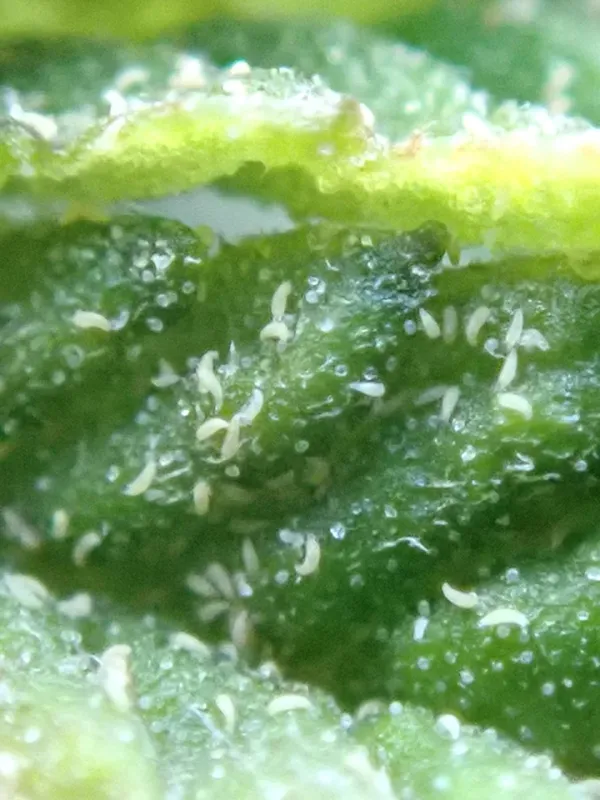
Adult mites have an elongated, wedge-shaped body that is typically pale yellow or white. Due to their minute size, they require at least 20x or 40x magnification to be observed during field inspections, usually hiding in leaf axils or on tender stem tips.
Their life cycle consists of the egg, nymph, and adult stages. Under favorable warm conditions, this cycle can be completed in just a few days, leading to rapid exponential growth of the population within a single crop cycle.
These mites are highly specialized to hemp plants, allowing them to thrive by extracting essential nutrients directly from plant cells. They tend to congregate in high-growth areas, such as developing flower clusters and new vegetative shoots.
Transmission of the pest is largely passive, occurring via wind, water irrigation splash, or human contact. Once introduced into a growing facility, they can colonize the entire area very quickly, necessitating immediate action.
What it damages
The hemp russet mite exclusively targets Cannabis sativa. Both indoor and outdoor crops are highly susceptible, with damage often manifesting as severe physiological stress that impacts both biomass and final harvest quality.
As the mites feed, they inject enzymes into the plant tissues, disrupting normal metabolic functions. This results in significant stunting, reduced node spacing, and abnormal leaf development, often leading to a total loss of commercial value.
The damage to flower production is particularly devastating. Infested buds may become stunted, brittle, and discolored, which severely degrades the marketability of the product and reduces the concentration of valuable plant compounds.
In addition to structural damage, the mite's feeding activity weakens the plant's natural defense systems. This creates entry points for various bacterial and fungal pathogens, potentially leading to widespread plant death across the field.
The impact is often cumulative; as the population density rises, the symptoms become more apparent, shifting from subtle leaf curling to massive necrosis of the upper plant parts as the colony spreads further down the stem.
Signs of infestation
Early symptoms include leaves that curl downwards and appear to be drying out, even when irrigation is sufficient. These leaves often take on a bronze or rusty tint, which is where the common name "russet mite" originates.
Growers should look for distorted growth or the presence of "witches' broom," where multiple thin, stunted stems sprout from a single node. This is a common physiological reaction to the toxins injected by the mites.
Flower clusters infested by these mites become brittle and may fail to develop properly. If left unchecked, the buds will turn brown or grey and eventually cease to expand, leading to poor yield and loss of plant vigor.
Plants often exhibit a lack of turgidity and appear wilted. Because these symptoms resemble drought stress or nutrient deficiencies, many growers misidentify the problem and waste time applying incorrect treatments.
Microscopic inspection of the stem surface or leaf undersides near the growing tips is the only way to confirm a diagnosis, where clusters of these translucent organisms can be found actively feeding near the base of hairs.
Control measures
Effective management of Aculops cannibicola requires a rigorous Integrated Pest Management (IPM) approach. The first line of defense is strict quarantine protocol to prevent the entry of infected cuttings or tools into the growing area.
Chemical control involves the use of specialized acaricides. It is critical to rotate between different modes of action to prevent the development of resistant mite populations, as this species is known to adapt quickly to common chemicals.
- Regular monitoring using a hand lens to detect early clusters.
- Prompt removal and destruction of infested plants to limit spreading.
- Use of biological controls such as predatory mites (e.g., Amblyseius species).
- Maintaining proper humidity and temperature levels to limit the mites' reproductive rate.
- Disinfecting all pruning tools with alcohol or appropriate solutions between plants.
Preventive strategies also include maintaining a clean environment by removing debris and weeds that may act as alternative hosts. Consistent documentation of scouting efforts allows for timely interventions before the infestation reaches economic thresholds.
Taxonomy
- Latin name
- Aculops cannibicola
- Order
- Mites
- Family
- Eriophyidae
- EPPO code
- ACUPCN
Discussion
No discussions yet — be the first.