
Ailanthus gall mite
Aculops atypta
Description
How to identify
The Ailanthus gall mite (Aculops atypta) is a microscopic pest belonging to the family Eriophyidae. These tiny organisms are impossible to detect with the naked eye, requiring high-magnification optics for identification.
These mites possess a typical elongated, vermiform body shape. Being nearly transparent or pale-colored, they are perfectly camouflaged against the leaf tissue of their host plant.
The biology of Aculops atypta is strictly tied to the Tree of Heaven (Ailanthus altissima). The mite induces the formation of specialized structures known as galls, which serve as both habitat and protection for the population.
They undergo rapid reproductive cycles, producing multiple generations throughout the growing season. The life cycle comprises egg, nymph, and adult stages, occurring primarily within the protection of the galls.
Since the Tree of Heaven is often treated as an invasive species in many parts of the world, this mite can be viewed as a naturally occurring biocontrol agent in some ecological contexts.
What it damages
The mite feeds exclusively on the tissues of Ailanthus altissima. It extracts cell contents using its piercing-sucking mouthparts, which triggers the plant to develop abnormal cell growth.
The primary damage is the physiological depletion of the leaf tissue. As the galls occupy the leaf surface, they disrupt photosynthesis and metabolic processes, weakening the overall vitality of the tree.
While a single gall causes minimal harm, heavy infestations lead to severe leaf deformation and localized tissue necrosis, significantly affecting the tree's health and visual appearance.
The physiological stress caused by persistent infestation may reduce the tree's resilience to secondary attacks by fungi or environmental stressors like drought and frost.
In urban landscapes, the aesthetic impact is the most noticeable form of damage, as the presence of numerous galls significantly degrades the visual quality of the foliage.
When it appears
Activity begins in early spring, as soon as the buds of the host tree break and new leaves emerge, allowing the overwintering adults to colonize the fresh tissue.
Peak population levels typically occur during late spring and mid-summer, when weather conditions are most favorable for the development of successive mite generations.
Throughout the summer months, the mites remain highly active within the galls, continuously reproducing and expanding the number of infested spots on the tree's leaves.
As autumn approaches, signaling the end of the growth season, the mites begin migrating from the drying galls toward overwintering sites like bud scales and bark crevices.
During the winter, the mites enter a state of diapause, waiting in protected areas for the warming temperatures of the following spring to restart the cycle.
Signs of infestation
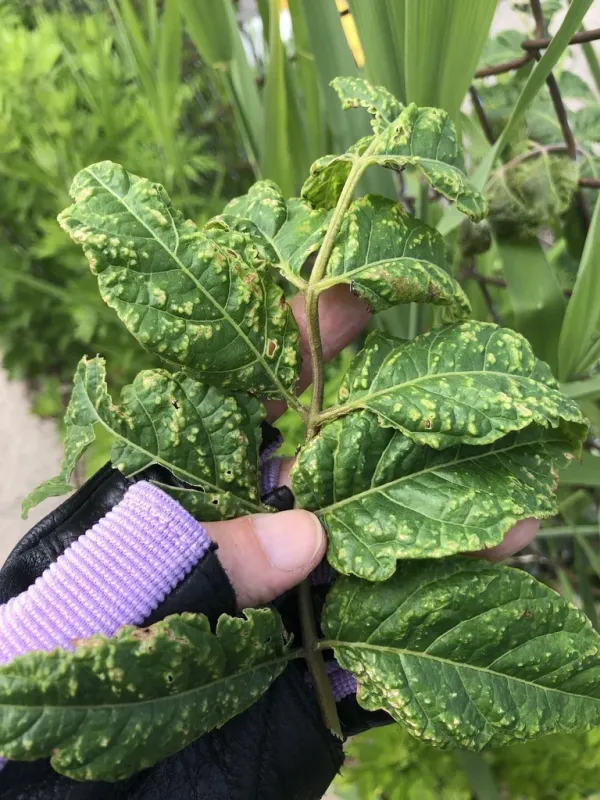
The most distinctive signs of infestation are the galls appearing on the upper leaf surface. These are abnormal, wart-like growths that clearly stand out from the surrounding tissue.
The galls often exhibit a variation in color, ranging from light green to reddish, which makes them highly visible as they develop on the foliage during the summer.
On the underside of the leaf, directly beneath the gall, one can often find a small opening or indentation that serves as the entry and exit point for the mites.
Leaf curling, thickening, and irregular growth patterns are common indicators that a colony of Aculops atypta is present and feeding on the leaf structures.
Severe infestations can eventually lead to the browning and necrosis of the leaves, resulting in premature leaf drop if the colonization density is sufficiently high.
Control measures
Management of the Ailanthus gall mite is challenging because the pests are sheltered inside the galls, making them largely inaccessible to surface-applied contact pesticides.
Systemic acaricides are considered the most effective control method, as they are absorbed into the plant's vascular system, ensuring that the mites ingest the toxin while feeding.
Sanitation practices, including the removal and destruction of heavily infested shoots or leaves, are effective for limiting local populations and preventing spread within smaller garden settings.
Biological control, such as encouraging natural predators like phytoseiid mites, may play a role in integrated pest management strategies to keep population levels in check.
Regular visual inspections of trees during the spring are crucial for early detection, allowing for timely interventions before the infestation becomes widespread across the tree canopy.
Taxonomy
- Latin name
- Aculops atypta
- Order
- Mites
- Family
- Eriophyidae
- EPPO code
- ACUPAT
Discussion
No discussions yet — be the first.