
Achaea janata
Achaea janata
Description
How to identify
Achaea janata, commonly known as the castor semi-looper, is a large moth belonging to the family Erebidae. It was historically classified within the Noctuidae family.
The adult moth has a wingspan ranging from 60 to 80 mm. Its forewings are typically grayish-brown with a complex dark pattern, while the hindwings are dark with white spots and a pale band.
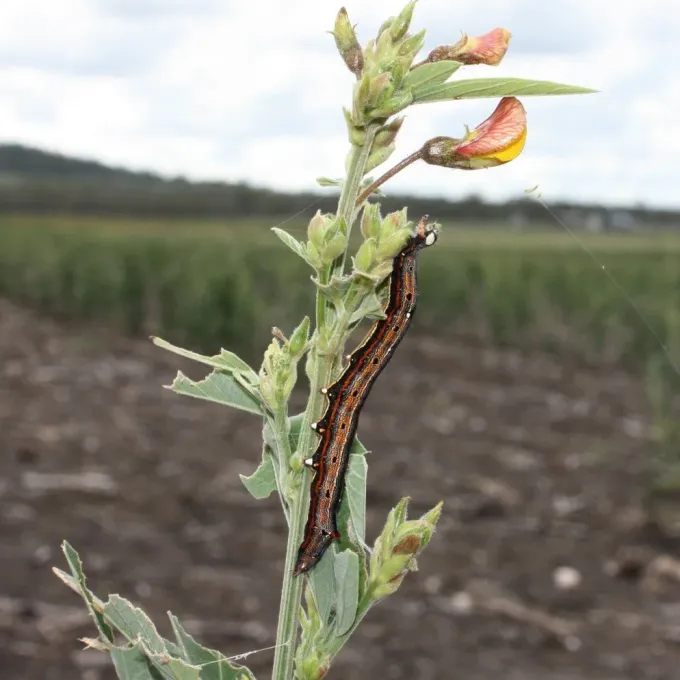
The larvae, which can grow up to 60–70 mm in length, exhibit significant color variations, ranging from pale green to dark brown, often with distinct spots along their bodies.
Pupation occurs in a dark brown pupa, often protected by a fine waxy secretion, which helps the insect survive during the dormant stages of its development.
The total life cycle is relatively rapid, typically lasting between 25 and 40 days, which allows the species to reproduce quickly under favorable environmental conditions.
What it damages
Achaea janata is a notorious polyphagous pest, meaning it feeds on a wide variety of plant species, causing substantial damage in both agricultural and horticultural sectors.
Major host plants include castor, pomegranate, citrus species, various legumes, and coconut palms, among many others across tropical and subtropical regions.
Young larvae initially skeletonize the leaves, consuming the leaf tissue while leaving the veins intact, which severely hinders the plant's ability to photosynthesize.
As they mature, the larvae become highly voracious, consuming entire leaves and occasionally damaging stems, which can lead to significant defoliation of the crop.
In fruit-bearing trees, the larvae may feed on young fruits and buds, directly impacting yield quality and leading to premature fruit drop.
When it appears
The adult moths are primarily nocturnal, making them most active in terms of flight and egg-laying during the night hours.
Population spikes are most frequently observed during warm and humid seasons when conditions are optimal for rapid larval growth and frequent reproduction.
The species thrives in temperature ranges between +25°C and +32°C, which accelerates its biological cycle and allows for multiple overlapping generations.
In regions with distinct seasons, the pest can emerge as soon as host plants start their growth phase, often creating significant pressure early in the season.
During unfavorable conditions, the insect can survive in the pupal stage, buried in the soil or under plant debris, awaiting the return of warmer weather.
Signs of infestation
Early symptoms of infestation include the presence of irregular holes in the leaves and visible skeletonization caused by young, active larvae.
The accumulation of frass (larval droppings) on the leaves or at the base of the plant is a clear indication of a significant larval infestation in the canopy.
Severe defoliation is a classic sign of a developed colony, with plants appearing stripped of their foliage and showing signs of significant stress.
Fruit damage manifests as surface blemishes and irregular bites, which often invite opportunistic fungal or bacterial infections to take hold.
Attraction to artificial light sources at night is a common behavioral trait, which can be used to monitor the presence of the adult moth in farming areas.
Control measures
Effective management of Achaea janata requires a combination of strategies to keep populations below the economic injury level.
- Implementing strict field sanitation by removing weeds and plant debris that can harbor larvae during the off-season.
- Promoting the presence of natural predators, such as birds, parasitic wasps, and various predatory insects that feed on larvae.
- Applying bio-pesticides, such as Bacillus thuringiensis, which target larvae specifically while being safe for beneficial organisms.
- Utilizing systemic or contact insecticides when monitoring indicates that the population has crossed the threshold for economic damage.
- Deploying light traps to monitor moth flight activity and timing control applications for when they are most likely to be effective.
Taxonomy
- Latin name
- Achaea janata
- Order
- Lepidoptera (butterflies)
- Family
- Erebidae
- EPPO code
- OPHIME
Discussion
No discussions yet — be the first.