
Achaea indicabilis
Achaea indicabilis
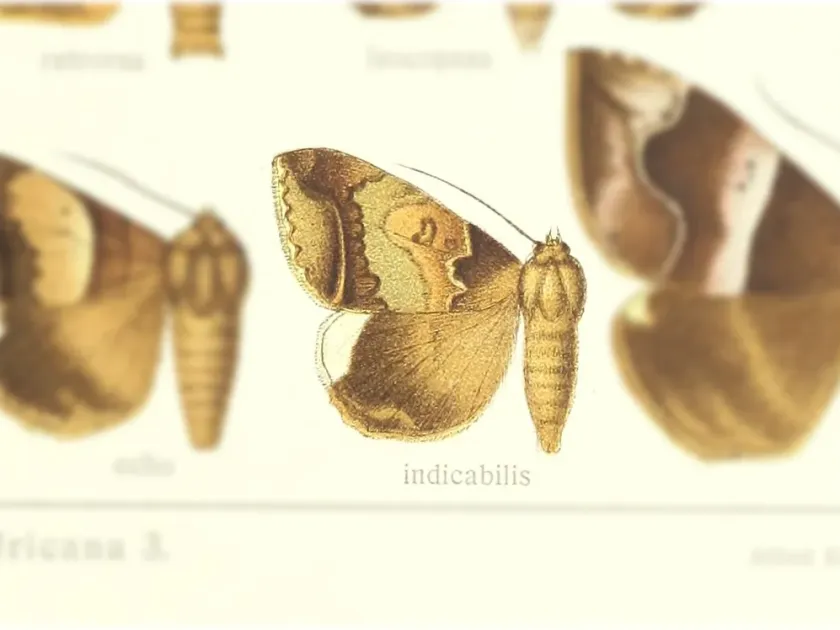
Description
How to identify
Achaea indicabilis belongs to the Erebidae family, within the order Lepidoptera. This moth is a typical nocturnal insect characterized by its cryptic coloration which provides excellent camouflage against tree bark or dry foliage.
Adult moths typically have a wingspan ranging from 50 to 70 mm. The forewings display intricate patterns in shades of grey and brown, while the hindwings may feature distinct spots used as a defense mechanism.
The larvae are typical of the Erebidae family, possessing several pairs of prolegs that allow for efficient movement across host plants. Their skin coloration often varies to blend with their immediate environment.
Identification of this species is usually based on morphological characteristics of the wings and, in technical contexts, by examining genital structures to distinguish it from closely related Achaea species.
The insects are generally active at night and remain motionless during the day, making manual detection in the field quite challenging without the use of light traps.
What it damages
Achaea indicabilis is a polyphagous pest capable of attacking a wide variety of plant species. The primary damage is caused by the larval stage, which feeds voraciously on the foliage of the host plant.
Defoliation is the most common symptom, where caterpillars consume the leaf blades, often leaving only the midribs and larger veins intact, which severely hampers the plant's photosynthetic capacity.
In cases of severe infestation, the pest can cause significant damage to young nursery stock and orchard trees, potentially leading to stunted growth or even the death of weakened plants.
Reproductive organs such as buds and young fruit may also be targeted, leading to direct yield loss and reduced marketability of the agricultural produce due to tissue damage.
The wounds inflicted by larvae provide entry points for secondary bacterial and fungal pathogens, which can exacerbate the physical damage caused by the feeding process.
When it appears
The life cycle of Achaea indicabilis is highly dependent on environmental temperature and the availability of food sources. The moths are most active during the warmer months of the year.
The pest produces multiple generations per season, with the development time of each generation being dictated by thermal accumulation and climate conditions in the habitat.
Oviposition typically occurs on the foliage of host plants, ensuring that neonate larvae have immediate access to food upon hatching, which maximizes their survival rate.
Populations tend to reach their peak in mid-summer, making this the critical window for monitoring and implementing control measures to prevent large-scale crop damage.
Overwintering occurs at the pupal stage, usually in sheltered locations such as soil crevices or under leaf litter, providing resilience against cold winter temperatures.
Signs of infestation
The most evident sign of infestation is irregular, notched, or completely destroyed leaf tissue, characteristic of lepidopteran feeding activity during the night.
Frass (larval droppings) found on leaves or at the base of the plant serves as a clear indicator of the presence and activity of larvae, even if the pests themselves are not immediately visible.
Silk webbing or tied-together leaves are common signs that larvae are using these structures for protection against predators and the elements during their resting periods.
Necrosis of damaged leaf margins, often turning brown or yellow, indicates that the plant tissue is dying as a result of the feeding pressure exerted by the caterpillar population.
Monitoring the adult population using light traps can provide an early warning system, allowing farmers to anticipate larval outbreaks and plan management strategies accordingly.
Control measures
Cultural control measures include maintaining field hygiene by removing weeds and crop debris, which act as hiding spots and potential wintering sites for the pupae.
Biological control can be effectively implemented by introducing natural predators or using environmentally friendly microbial insecticides like Bacillus thuringiensis to manage larval populations.
Chemical control should be applied based on economic injury levels. Systemic or contact-stomach insecticides are used to control the larvae, ensuring that application is timed for the most susceptible life stage.
Resistance management is crucial, involving the rotation of insecticides with different modes of action to ensure that the pest does not develop tolerance to standard treatments.
Regular field scouting is essential for the timely detection of pest clusters, which allows for spot-spraying and reduces the overall volume of pesticides applied to the entire area.
Taxonomy
- Latin name
- Achaea indicabilis
- Order
- Lepidoptera (butterflies)
- Family
- Erebidae
- EPPO code
- ACAEIN
Discussion
No discussions yet — be the first.