
Achaea finita
Achaea finita
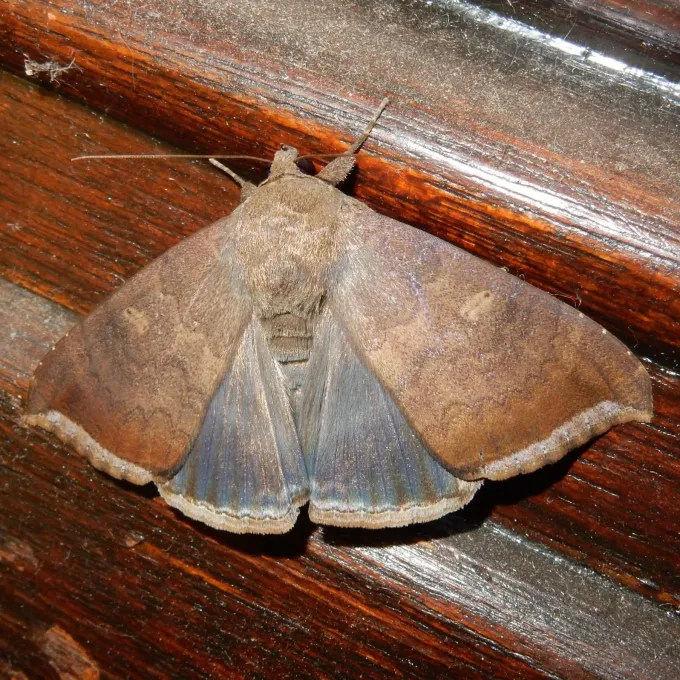
Description
How to identify
Achaea finita belongs to the family Erebidae, which was previously classified within the broader Noctuidae (owlet moths) family. This insect has a wingspan of approximately 40–50 mm, typical for the genus.
Adults possess cryptic coloration, allowing them to effectively blend in with tree bark or dry vegetation during daylight hours.
The forewings have brownish-grey tones with intricate wavy lines and spots, which help them mimic damaged foliage or debris.
Larvae of this species are known for their strong mimicry; their bodies are often colored to match the leaves or stems of their host plants.
To accurately identify adults, entomologists perform dissections of the genitalia, as the external appearance can be similar to other members of the Achaea genus.
What it damages
The primary damage is caused by the larval stage—the caterpillars—which actively feed on the vegetative parts of various plant species.
In their natural habitat, they prefer the leaves of trees and shrubs, often damaging buds and tender new growth shoots.
In agricultural settings, the pest may move to crops if they are growing near primary breeding sites or natural reservoirs.
Intensive feeding by the caterpillars leads to defoliation, which significantly reduces the plant's photosynthetic capacity and stunts overall development.
Mass outbreaks of this pest can result in severe loss of green biomass, posing a direct threat to crop yield and plant health.
When it appears
The insect's development is directly influenced by regional climatic conditions and the temperature regime during the growing season of crops.
Adult moth activity typically peaks during the warm months, providing optimal conditions for mating and oviposition.
Caterpillars are most active during periods of rapid plant growth, ensuring abundant food sources for their successful development.
The life cycle encompasses several stages: egg, caterpillar, pupa, and adult, with the number of generations per year varying between one and two.
The overwintering stage usually occurs as a pupa within the soil substrate or protected cracks in bark, ensuring survival through cold temperatures.
Signs of infestation
The first sign of infestation is the presence of characteristic "windowing" damage or complete skeletonization of the leaf blades.
The accumulation of caterpillar frass (excrement) on the underside of leaves and on the ground beneath the canopy is a clear indicator of active feeding.
Rolled or deformed young leaves often reveal the location of smaller larvae that hide within the folds for protection.
Adults can be detected during evening visual surveys or by using light traps, as they are strongly attracted to artificial light sources.
- Presence of holes and missing leaf tissue.
- Direct sighting of caterpillars during plant inspections.
- Loss of turgor and wilting of individual branches during heavy infestations.
Control measures
Protection strategies involve an integrated approach, utilizing agrotechnical, biological, and chemical methods to suppress populations.
Timely weeding and removal of alternative host plants help decrease the pest's population and limit its spread into cultivated fields.
When population density reaches economic damage thresholds, the use of systemic or contact-stomach insecticides registered for specific crops is recommended.
Biological control methods, such as products containing entomopathogenic bacteria or fungi, allow for effective caterpillar management while minimizing environmental impact.
Monitoring using pheromone traps is essential for forecasting population peaks and timing control efforts for maximum efficiency.
Taxonomy
- Latin name
- Achaea finita
- Order
- Lepidoptera (butterflies)
- Family
- Erebidae
- EPPO code
- ACAEFI
Discussion
No discussions yet — be the first.