
Willow gall mite
Aceria vaga
Description
How to identify
The willow gall mite (Aceria vaga) is a microscopic pest belonging to the Eriophyidae family. Due to their minute size, approximately 0.15–0.2 mm, they are invisible to the naked eye.
These mites have an elongated, worm-like body, which is a characteristic feature of this family, covered with fine rings, typically appearing whitish or pale yellow under a microscope.
Their life cycle is highly adapted to the host tree, with adult females overwintering in bark crevices, bud scales, or protected areas on the willow branches.
As soon as temperatures rise in the spring and buds begin to swell, the mites emerge from their winter dormancy to colonize the young, emerging leaves.
Multiple generations can develop throughout the growing season, allowing the mite population to increase rapidly if environmental conditions are favorable.
What it damages
The willow gall mite is a host-specific pest that exclusively infests various species of willow (Salix). It feeds on the soft tissue of leaves and young succulent shoots.
The feeding process triggers the plant to form abnormal growths known as galls, which serve as a habitat and nutrient source for the mite colony.
While mature, established trees can often tolerate some level of infestation, young nursery stock or trees in landscape settings can suffer significantly.
Severe infestations can lead to substantial leaf disfigurement, reducing the tree's photosynthetic capability and potentially causing stunted overall growth.
Repeated yearly infestations stress the tree, making it more susceptible to secondary environmental stresses or opportunistic pathogen attacks.
Signs of infestation
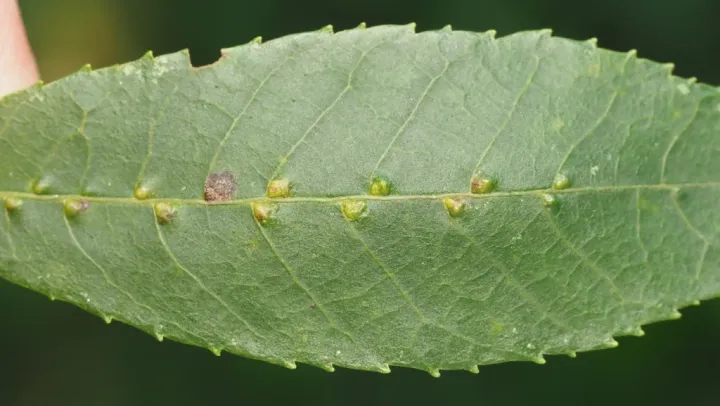
The primary symptom of an infestation is the formation of galls on the leaf surface. These appear as small, elongated, spine-like, or scale-like projections.
While initially green, these galls often turn shades of red, brown, or black as the season progresses, making them quite distinct against the green leaf tissue.
Heavily infested leaves often appear twisted, curled, and distorted, which detracts from the ornamental value of the willow tree.
The interior of these galls provides a protected microenvironment where the mites feed and reproduce, hidden away from many predators and environmental factors.
By late summer or autumn, affected leaves often lose their vigor prematurely, eventually leading to early leaf drop in heavily infested branches.
Control measures
Managing the willow gall mite requires a targeted approach, primarily using acaricides specifically formulated to control eriophyid mites.
The most critical window for treatment is during the spring when the mites migrate from their overwintering sites to the developing buds.
Because the mites live inside the galls, contact-based treatments are often ineffective after the galls have fully formed, necessitating timing precision.
Sanitation practices play a vital role in integrated pest management, as removing heavily infested branches helps reduce the overwintering population.
- Apply systemic acaricides during early bud break.
- Prune and destroy severely infested branches in autumn.
- Rake and dispose of all fallen foliage to prevent overwintering.
- Maintain tree health through proper watering and fertilization.
Taxonomy
- Latin name
- Aceria vaga
- Order
- Mites
- Family
- Eriophyidae
- EPPO code
- ACEIVG
Discussion
No discussions yet — be the first.