
Tulip bulb mite
Aceria tulipae
Description
How to identify
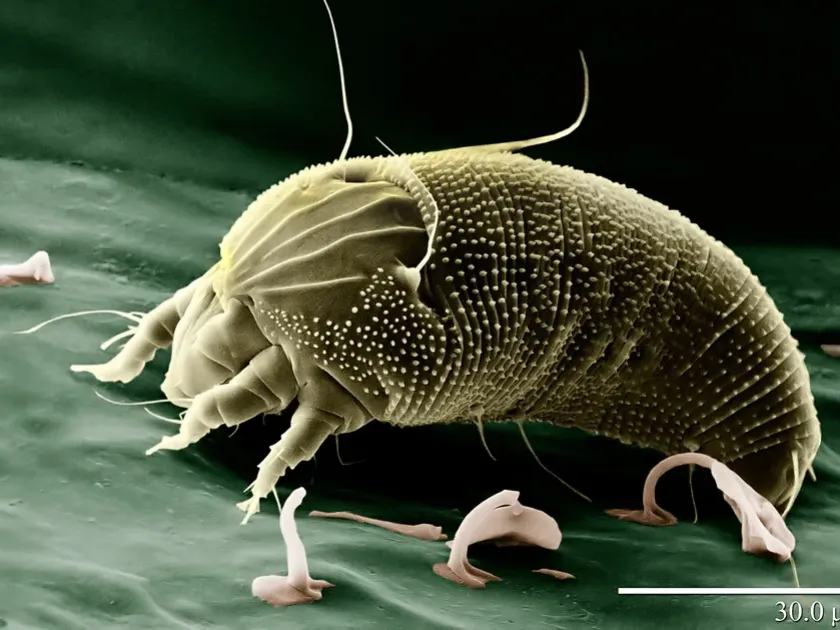
The tulip bulb mite (Aceria tulipae) is a member of the Eriophyidae family. These are microscopic pests characterized by an elongated, worm-like body that is pale white or yellowish in color.
Unlike common spider mites, they possess only two pairs of legs situated at the front end. Measuring approximately 0.2 mm, they are virtually invisible to the naked eye, requiring magnification for proper identification.
They inhabit the inner scales of bulbs, where they reside in hidden colonies. Their biology is adapted for living within the tight spaces between protective leaf scales.
Their life cycle is highly temperature-dependent, accelerating rapidly in warm conditions between 15°C and 25°C. The rapid turnover of generations allows populations to explode quickly.
Beyond direct physical damage, these mites act as primary vectors for several harmful plant viruses, specifically the tulip breaking virus.
What it damages
This mite infests various bulbous plants, with tulips, lilies, hyacinths, daffodils, and garlic being the most susceptible hosts.
The mites feed on the plant tissues, causing dehydration and tissue collapse. This damage facilitates secondary infections by fungal pathogens, leading to bulb rot.
Infested storage material suffers from shriveling and poor quality. This leads to substantial losses in the commercial production of flower bulbs.
When planted, infested bulbs produce weak, stunted growth. Stems may appear twisted, and leaf development is often distorted and mosaic-patterned.
Flowering is significantly impacted; the blooms may be deformed, fail to open properly, or display color-breaking symptoms associated with viral transmission.
Signs of infestation
The primary symptom of infestation is the appearance of necrotic, brown, or sunken spots on the bulb scales or the basal plate.
In cases of heavy infestation, the bulbs lose their firm texture, become spongy, and emit a musty odor due to the colonization of secondary bacteria and fungi.
As the plant emerges, leaf symptoms include curling, narrowing, and distinct yellow-green mottling or mosaic patterns across the foliage.
Floral stems are often reduced in height and may appear curled or stunted. The petals themselves may show irregular white or dark streaks indicating viral stress.
- Shriveled and deformed bulbs in storage.
- Stunted shoot emergence in spring.
- Severe deformation of leaf tissue.
- Poor bulb formation and rotting at the base.
Control measures
Rigorous culling is the most effective preventative measure. Any bulbs showing signs of damage, staining, or necrosis must be discarded and destroyed immediately.
Hot water treatment (soaking bulbs in 45°C water for 15-20 minutes) is an effective non-chemical method to sanitize bulbs before planting.
Proper storage is essential; keeping bulbs in cool, dry conditions with adequate ventilation prevents the rapid multiplication of mites within the stored batch.
Chemical control involving systemic acaricide dips for bulbs before planting can significantly reduce the risk of successful infestation in the field.
Crop rotation is vital. Do not replant host bulbs in the same soil for at least three to four years to ensure that any residual mite population in the soil dies off.
Taxonomy
- Latin name
- Aceria tulipae
- Order
- Mites
- Family
- Eriophyidae
- EPPO code
- ACEITU
Discussion
No discussions yet — be the first.