
Wheat curl mite
Aceria tosichella
Description
How to identify
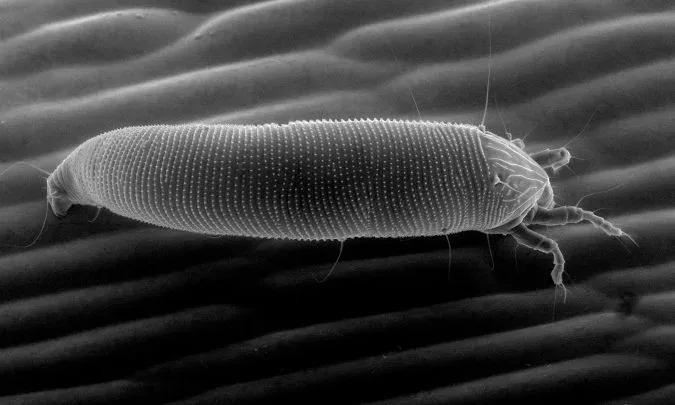
The wheat curl mite (Aceria tosichella) belongs to the order Acariformes, family Eriophyidae. It is a microscopic pest with a worm-like body, measuring only about 0.2 mm in length.
The mite's color ranges from whitish to yellowish-translucent. Due to their extremely small size, these pests are almost impossible to detect with the naked eye, requiring laboratory equipment or powerful magnification.
Adults have only two pairs of legs located at the front of the body, which is a characteristic diagnostic feature of this family. Larvae look similar to adults but are significantly smaller in size.
Development occurs exclusively on living plant tissues, and the mite cannot move long distances on its own. The primary method of dispersal is by wind currents, which carry the mites between fields.
The life cycle is very short, allowing for up to 5–6 generations per growing season under favorable conditions. Optimal conditions for their survival are moderately warm and dry weather.
What it damages
The main host crops include winter and spring wheat. The mite also successfully infests barley, oats, millet, and various wild grass species that serve as reservoirs for the pest.
Damage occurs not only through direct feeding on plant sap but also through the transmission of dangerous viral diseases. The mite is the primary vector of the Wheat Streak Mosaic Virus (WSMV).
During mass outbreaks, the pest colonizes young cereal shoots, nesting in rolled young leaves or leaf axils. This leads to plant weakening and significant yield losses.
The most severe damage occurs in the autumn on winter cereal crops, where the mite concentrates on emerging seedlings. Affected plants exhibit stunted growth, reduced tillering, and decreased cold hardiness.
The economic threshold for damage depends directly on the level of viral infection in the fields, as even a small population of mites can trigger a large-scale viral epidemic.
When it appears
The pest primarily overwinters as an adult on winter cereal seedlings, volunteer grain, and weeds. In warm seasons, it persists on perennial grasses.
In spring, when average daily temperatures exceed +10°C, the mites begin active migration and reproduction. Peak population density often coincides with the jointing stage of cereal crops.
During summer, in hot and dry weather, mite activity may temporarily decline, although they continue to thrive on actively growing weeds or late-planted spring crops.
In autumn, following the emergence of winter crops, mass migration occurs from weed hosts and crop residues to the new seedlings. This period is critical for the transmission of viral diseases.
Weather factors, such as a prolonged warm autumn or an early warm spring, facilitate a sharp increase in population, making pest management a challenging task for agronomists.
Signs of infestation
A characteristic sign of damage is the inward curling of leaf edges, creating tube-like structures where colonies of mites hide and feed.
When infected with the Wheat Streak Mosaic Virus, leaves develop light yellow-green streaks or stripes that run parallel to the leaf veins.
Affected plants appear stunted, show signs of severe stress, and often fail to produce a grain head. In cases of high infestation, massive yellowing and premature leaf senescence are observed.
Damaged patches in a field often appear in clusters, spreading in the direction of prevailing winds, which transport the mites from infected areas to healthy plants.
- Leaf blade deformation.
- Development of chlorotic streaks and stripes.
- Stunted growth and dwarfing.
- Reduced tillering in winter crops.
- Plant death in severely infested patches.
Control measures
The primary control measure is the implementation of crop rotation and maintaining spatial isolation between new winter cereal fields and those that grew cereals in the previous season.
It is crucial to control volunteer grain and grassy weeds effectively, as these serve as the primary reservoirs for mite accumulation during the summer months.
Optimizing planting dates for winter crops helps avoid mass colonization of seedlings by mites in the autumn. Very early planting increases the risk of infestation.
Chemical control includes the application of acaricides, although the effectiveness of treatments is often limited due to the pest's hidden lifestyle inside rolled leaves.
To prevent viral infections, it is recommended to use resistant crop varieties and ensure mandatory seed treatment with systemic insecticides, which provide protection for seedlings during the early growth stage.
Taxonomy
- Latin name
- Aceria tosichella
- Order
- Mites
- Family
- Eriophyidae
- EPPO code
- ACEITO
Discussion
No discussions yet — be the first.