
Beech leaf gall mite
Aceria stenaspis
Description
How to identify
The beech leaf gall mite (Aceria stenaspis) is a microscopic pest belonging to the Eriophyidae family. These mites are characterized by a vermiform, elongated, and cylindrical body, which makes them barely visible without the use of a magnifying lens.
The life cycle of this mite is highly specialized and synchronized with the phenology of the beech tree (Fagus). Adults overwinter in protected niches, such as bark crevices or dormant buds, and emerge as the tree starts its growth phase in early spring.
Once the buds begin to burst, the mites migrate to the young, developing leaves to feed and lay eggs. Throughout the growing season, multiple generations can occur, leading to significant populations if the environmental conditions remain favorable.
Dispersal is primarily passive, occurring through wind currents, rain splashing, or hitchhiking on insects and birds. This allows the mites to spread throughout individual trees and to neighboring specimens in forests or urban parks.
The species is considered host-specific, meaning it has evolved exclusively to parasitize beech trees. This evolutionary strategy allows the mite to thrive in a stable microenvironment, effectively utilizing the host's physiological resources.
What it damages
The primary host for Aceria stenaspis is the European beech. The damage is restricted to the leaf tissue, where the mite feeds by piercing cells and injecting saliva that contains growth-regulating substances.
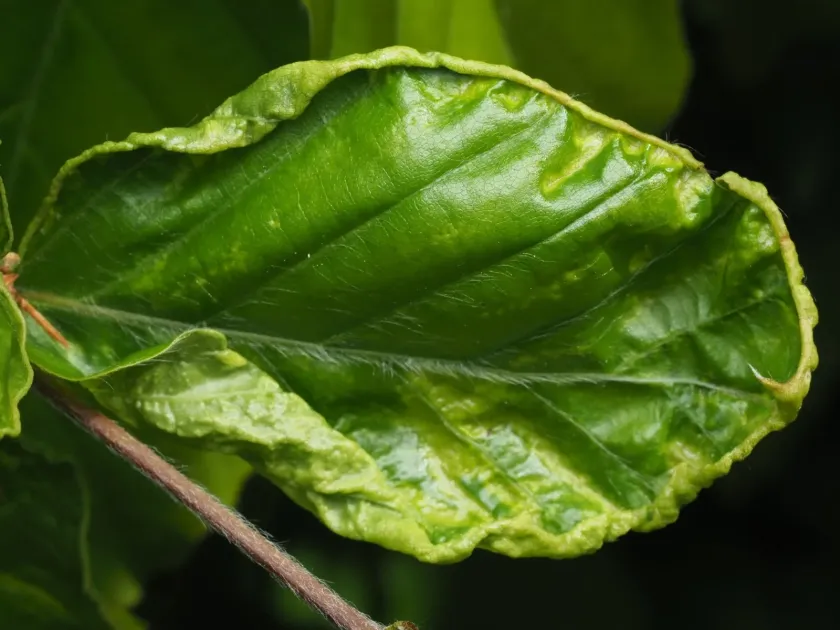
This feeding behavior causes the host plant to produce abnormal cellular growth, resulting in characteristic leaf distortions. These deformities may appear as small galls, curls, or irregular thickening of the leaf blades, which disrupts normal leaf development.
The primary impact of heavy infestation is the reduction of photosynthetic efficiency. By deforming the leaf structure and disrupting cell functions, the mite lowers the tree's ability to produce energy, potentially weakening its overall vitality.
In ornamental garden settings, the aesthetic impact is significant as the foliage becomes puckered, stunted, and discolored. While mature trees rarely succumb directly to the mites, they may become stressed and more susceptible to environmental factors.
Secondary damage often arises as the mite-induced lesions create entry points for opportunistic fungal pathogens. This can lead to necrotic spots on leaves, further exacerbating the stress on the host tree during the peak summer months.
Signs of infestation
The first signs of infestation become apparent in late spring as the foliage unfurls. You may notice subtle curling or twisting of the leaf margins, which is the initial reaction of the tissue to the mite colonies.
As the season progresses, yellowish or reddish-brown patches appear on the leaves. These areas are often where the mites are actively feeding, leading to localized tissue death or discoloration that stands out against the green leaf.
Close inspection of the leaf surface often reveals small depressions or pockets, sometimes referred to as erineum or gall-like structures. These serve as shelters for the mites, protecting them from predators and environmental fluctuations.
Severe infestations manifest as generalized wrinkling and puckering of the entire leaf. Affected leaves may be smaller in size and appear brittle or thickened, losing their typical flexible texture and smooth appearance.
In extreme cases, premature leaf drop may occur. Trees may appear sparse or sickly by mid-summer, with yellowing foliage that fails to provide the deep, lush canopy characteristic of healthy beech trees.
Control measures
Managing the beech leaf gall mite requires a proactive approach. In nursery environments, the timely application of systemic acaricides is the most effective way to reach the mites residing within the leaf tissues.
Cultural practices, such as the pruning and removal of heavily infested twigs, can help reduce the local population of overwintering mites. This should be done during the dormant season to minimize the source of re-infestation for the following year.
Promoting the presence of predatory mites, such as those in the Phytoseiidae family, is a sustainable biological control method. Avoiding broad-spectrum insecticides helps preserve these natural enemies, which can keep mite populations in check.
Maintaining high plant vigor through proper watering and fertilization can help the trees withstand the damage. A healthy, well-nourished tree is generally more resilient to the physiological stress caused by eriophyid mite feeding.
For high-value ornamental trees, monitoring should begin at the first bud break. Early detection is crucial, as once the leaves are fully formed and galls are established, the mites become much harder to reach with conventional treatments.
Taxonomy
- Latin name
- Aceria stenaspis
- Order
- Mites
- Family
- Eriophyidae
- EPPO code
- ACEISS
Discussion
No discussions yet — be the first.