
Aceria pallida
Aceria pallida
Description
How to identify
Aceria pallida is a microscopic, plant-feeding mite belonging to the Eriophyidae family. These pests are known as gall mites or four-legged mites because adult individuals possess only two pairs of legs, which are situated near the front of their body.
The body of this mite is elongated, vermiform, and pale in color. Due to their minute size, they are virtually invisible to the naked eye, making early detection a significant challenge for growers and farmers alike.
Aceria mites spend the winter months in protected niches, such as under bud scales or within deep cracks in the plant bark. As temperatures rise in the spring, they emerge to commence feeding and reproduction cycles.
The life cycle of Aceria pallida is closely synchronized with the phenology of the host plant. Under favorable conditions, the mite can produce multiple overlapping generations, leading to a rapid buildup of the pest population.
Taxonomically, this species belongs to the order Acariformes. They are specialized phytophages, evolved to manipulate plant growth hormones, which results in the creation of protective structures like galls.
What it damages
Aceria pallida primarily targets specific plant species, notably within the Asteraceae family. It feeds by piercing plant cells and extracting the sap, while simultaneously injecting salivary enzymes into the host tissue.
The mite prefers to colonize actively growing tissues, such as young leaves, apical shoots, and developing flower buds. This localized feeding creates metabolic stress that diverts the plant's resources away from healthy growth.
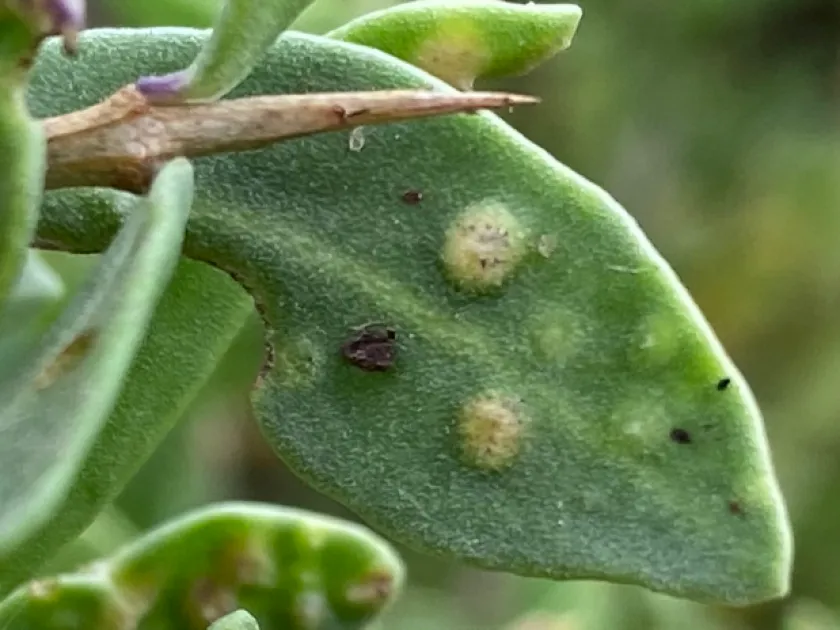
Damage symptoms include severe deformation of leaves and buds, often leading to reduced plant vigor, stunted growth, and a significant decrease in the quality of the foliage or flowers.
In nursery settings, a heavy infestation of Aceria pallida can lead to total loss of product. The aesthetic damage caused by the mites makes the plants unsellable and requires strict containment measures.
Beyond direct feeding damage, these mites act as vectors for secondary pathogens. The mechanical damage to plant cells provides easy entry points for various bacteria and fungi that cause necrotic spots and rot.
Signs of infestation
The first signs of an Aceria pallida infestation are often mistaken for environmental stress or viral infections. Look for abnormal leaf curling, crinkling, or stunted development of the shoots.
The appearance of galls — abnormal swelling or growth of plant tissue — is a classic diagnostic sign. These growths can range from small bumps to dense patches of fuzzy hair-like structures (erinea).
Terminal growth often becomes bushy, a symptom sometimes called "witches' broom," where the plant loses its natural architecture due to the death of primary growing points and excessive proliferation of lateral buds.
Microscopic examination is necessary for a definitive diagnosis. Using a 20x hand lens, one may observe the slow-moving, cigar-shaped mites on the undersides of leaves or hidden deep within buds.
- Deformed and curled leaves.
- Presence of characteristic galls or fuzzy outgrowths.
- General chlorosis (yellowing) of the tissue.
- Stunted shoot growth and loss of apical dominance.
Control measures
Controlling Aceria pallida is difficult because the mites are often protected inside galls or bud scales. Contact pesticides often fail to reach these hidden colonies, necessitating the use of systemic products.
Effective management requires the application of specialized acaricides. These treatments are most successful when timed with the mites' migration phase, typically during early spring or immediately after flowering.
Sanitation is a critical component of pest control. Severely infested plant parts should be pruned, removed, and destroyed by burning or deep burial to prevent the spread of the population to healthy areas.
Quarantine and strict inspection of new plant stock are vital. Introducing an infested plant into a clean garden or field can lead to rapid infestation of the entire area, as the mites are easily wind-dispersed.
Integrated Pest Management (IPM) practices, including proper plant nutrition to boost host immunity and the use of soft-soap or horticultural oil sprays, can help mitigate damage and promote recovery after primary treatments.
Taxonomy
- Latin name
- Aceria pallida
- Order
- Mites
- Family
- Eriophyidae
- EPPO code
- ACEIPI
Discussion
No discussions yet — be the first.