
Olive bud mite
Aceria oleae
Description
How to identify
The olive bud mite (Aceria oleae) is a microscopic pest belonging to the Eriophyidae family. It is a highly specialized mite that exclusively targets olive trees.
The mite has a worm-like body, white or yellowish, and is so small (approximately 0.2 mm) that it cannot be seen without a high-powered microscope.
Their life cycle consists of eggs, larvae, nymphs, and adults. Reproduction is rapid during the warm months, allowing several generations to occur within a single growing season.
They survive the winter as adults, hiding deep within the bud scales or in the bark crevices of the olive trees, emerging when spring temperatures rise.
Wind dispersal is the primary method of spread between trees, although they can also be carried over long distances via infested nursery planting material.
What it damages
The mite attacks young shoots, developing leaves, and buds of the European olive (Olea europaea). The feeding action causes cellular damage and growth abnormalities.
By injecting toxic enzymes into the plant tissue, the mites stimulate the growth of pathological tissues, known as galls, which serve as protection and food sources for the colony.
High infestations can lead to significant stunting of young shoots, affecting the overall structural integrity of the tree canopy in new plantations.
In mature orchards, severe damage to the buds can significantly reduce the number of inflorescences, leading to reduced fruit set and lower seasonal yields.
Furthermore, weakened trees are more susceptible to secondary infections and abiotic stresses, as the mites compromise the plant's physiological efficiency.
Signs of infestation
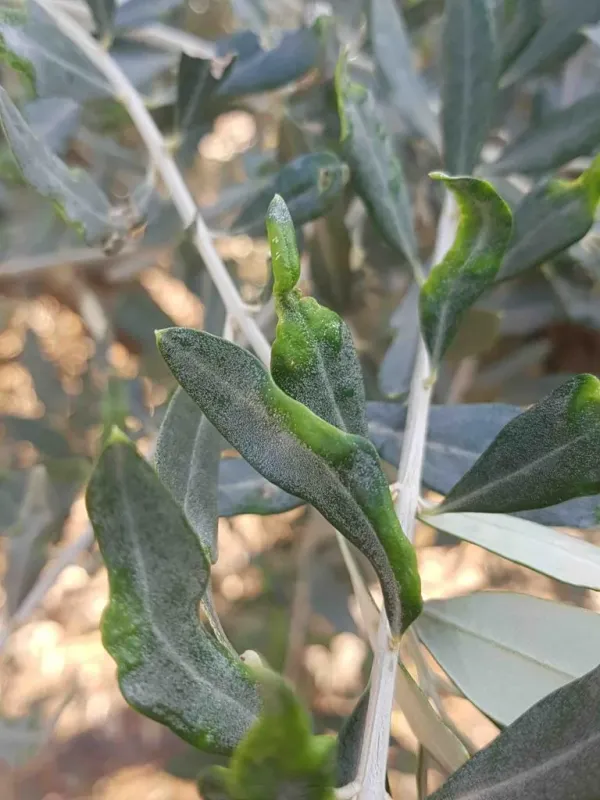
The most characteristic sign is the formation of galls — abnormal swellings or malformations on buds and leaves. These areas often appear puckered or deformed.
Infested leaves may show chlorosis (yellowing) or crinkling. In some cases, the buds fail to open properly and remain stunted, leading to a "witches' broom" growth pattern.
Buds may dry out and fall prematurely. If you inspect the interior of a symptomatic bud under magnification, you can often see the mite colony as a fine white powder.
Growth distortion is especially evident in the spring when new foliage emerges; the young leaves may appear curled or twisted due to the early-season feeding.
Reduced vigor of the shoot tips is another indicator. If shoot growth is consistently retarded compared to neighboring healthy trees, mite infestation should be suspected.
Control measures
Effective management requires a proactive approach, combining chemical treatments with cultural practices to break the mite's lifecycle.
Chemical control usually involves the application of specific acaricides. It is critical to time these applications during the early spring as the mites emerge from their winter shelter.
Sanitation is key; pruning and destroying heavily infested branches helps to significantly lower the mite population within the orchard.
Proper nitrogen management is recommended, as excessive nitrogen results in vigorous, succulent growth that is highly attractive to the mites for colonization.
- Utilize sulfur-based sprays, which are often effective in reducing mite density.
- Perform strict quarantine and inspection of new saplings before planting.
- Promote overall tree health through adequate irrigation and balanced mineral fertilization.
Taxonomy
- Latin name
- Aceria oleae
- Order
- Mites
- Family
- Eriophyidae
- EPPO code
- ACEIOL
Discussion
No discussions yet — be the first.