
Bermuda grass mite
Aceria neocynodonis
Description
How to identify
The Bermuda grass mite (Aceria neocynodonis) is a microscopic pest belonging to the Eriophyidae family. These arthropods are so small that they are completely invisible to the naked eye, requiring a microscope for accurate identification.
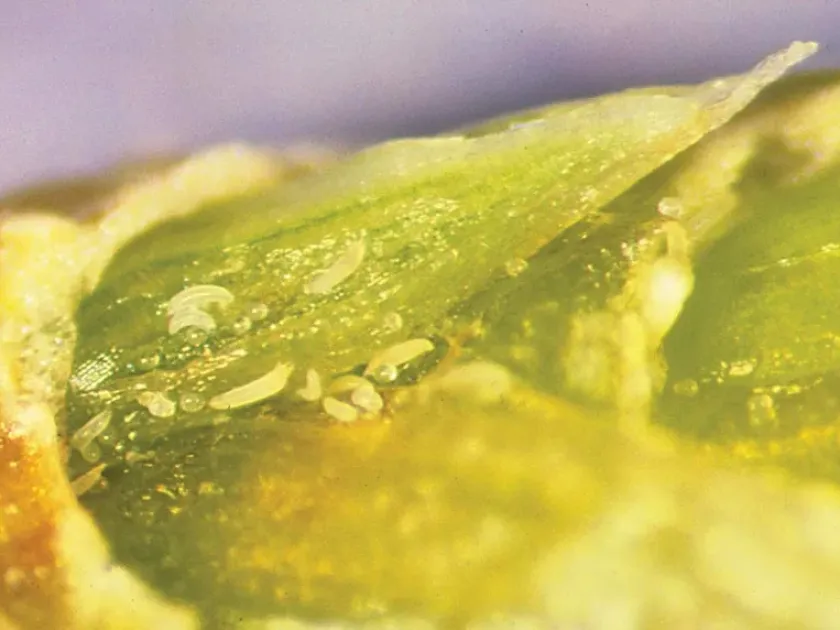
Adult mites have an elongated, worm-like body, typically white or translucent. A key identification feature of this family is the presence of only two pairs of legs, which are located at the front end of their body.
These mites inhabit protected areas of the host plant, mainly residing in leaf axils and beneath leaf sheaths. This environment provides them with essential shelter from environmental stressors and pesticides.
The life cycle of the mite is rapid, consisting of eggs, two nymphal stages, and adults. Under warm, optimal conditions, a full generation can develop within a week, leading to explosive population growth.
Dispersal occurs primarily via wind currents that carry the mites between lawn areas. Additionally, humans inadvertently contribute to their spread through mowing equipment and contaminated lawn clippings.
What it damages
The primary host for this pest is Bermuda grass (Cynodon dactylon), which is highly valued for sports fields and residential lawns. The mite feeds exclusively on the vegetative tissues of this grass.
By extracting cell contents, the mites induce a physiological reaction in the plant. They secrete substances that trigger abnormal development of the turf, leading to weakened plants and thinning stands.
Severe infestations result in significant aesthetic damage. The turf loses its density, becomes patchy, and shows clear signs of stress that cannot be corrected by standard watering or fertilization practices.
Beyond cosmetic issues, the weakened grass becomes susceptible to secondary infections and environmental extremes. This can lead to the total loss of the turf grass cover in heavily infested spots.
The economic impact is particularly significant for golf courses and athletic fields, where turf quality standards are exceptionally high and recovery requires costly interventions.
Signs of infestation
The most iconic symptom of a Bermuda grass mite infestation is the "witches' broom" effect. This is characterized by excessive branching of the stems at the nodes, resulting in stunted, dense, and rosette-like growth patterns.
Leaves on infested plants appear distorted, thickened, or curled. The shortening of internodes causes the grass to lose its typical growth habit, resulting in a clumped or tufted appearance.
Infested areas often start as localized patches of yellowing or browning. These symptoms are frequently misidentified as drought stress or nutrient deficiencies, which delays proper diagnosis and treatment.
During the peak of the season, infested patches may appear discolored compared to the surrounding healthy lawn. Close examination reveals the characteristic morphological changes in the plant architecture.
Confirmation of the presence of Aceria neocynodonis is achieved by inspecting tissue samples under a microscope, where colonies of the mites are found hidden within the leaf sheaths.
Control measures
Successful management begins with good cultural practices. Proper nitrogen fertilization and deep, efficient irrigation help the grass recover from the stress induced by the mites.
Strict sanitation is vital. Mowing equipment should be thoroughly cleaned after maintaining infected areas to prevent the mechanical transport of mites to healthy parts of the lawn.
When populations exceed thresholds, chemical control using acaricides is necessary. Products must be applied with adequate water volume and surfactants to penetrate the protective leaf sheaths.
Rotation of chemical classes is recommended to prevent the development of pesticide resistance in mite populations. Application timing should coincide with the peak activity of the pest during the growing season.
- Monitor turf regularly for stunted or distorted growth.
- Sanitize all lawn maintenance tools.
- Apply systemic acaricides when infestations are confirmed.
- Maintain optimal soil fertility to promote grass vigor.
- Remove and dispose of severely damaged turf material.
Taxonomy
- Latin name
- Aceria neocynodonis
- Order
- Mites
- Family
- Eriophyidae
- EPPO code
- ACEINC
Discussion
No discussions yet — be the first.