
Mango bud mite
Aceria mangiferae
Description
How to identify
The Mango bud mite (Aceria mangiferae) is a microscopic member of the Eriophyidae family. These tiny, worm-like mites are approximately 0.2 mm long and possess a creamy white color, making them virtually impossible to detect without professional magnification tools.
The biological cycle of this pest is intricately linked to the mango tree's growth stages. The life cycle comprises egg, nymph, and adult stages, with rapid reproduction rates in warm, humid tropical environments where mangoes thrive.
Adults primarily inhabit the crevices within the buds, leaf axils, and under the bark scales. This cryptic behavior provides significant protection against environmental stressors and many standard contact pesticides, making control efforts challenging.
Transmission occurs mainly via wind currents carrying mites to new hosts. Additionally, human activities, such as using contaminated pruning tools or transporting infested nursery stock, play a major role in the wide dispersal of the pest across agricultural regions.
A critical scientific fact is the mite's role as the primary vector for the fungus Fusarium mangiferae. This pathogen is responsible for mango malformation disease, which turns healthy buds into vegetative and floral clusters that fail to produce fruit.
What it damages
The primary host for Aceria mangiferae is the mango tree (Mangifera indica). It affects both wild and commercial cultivars globally, with serious implications for export-oriented mango production.
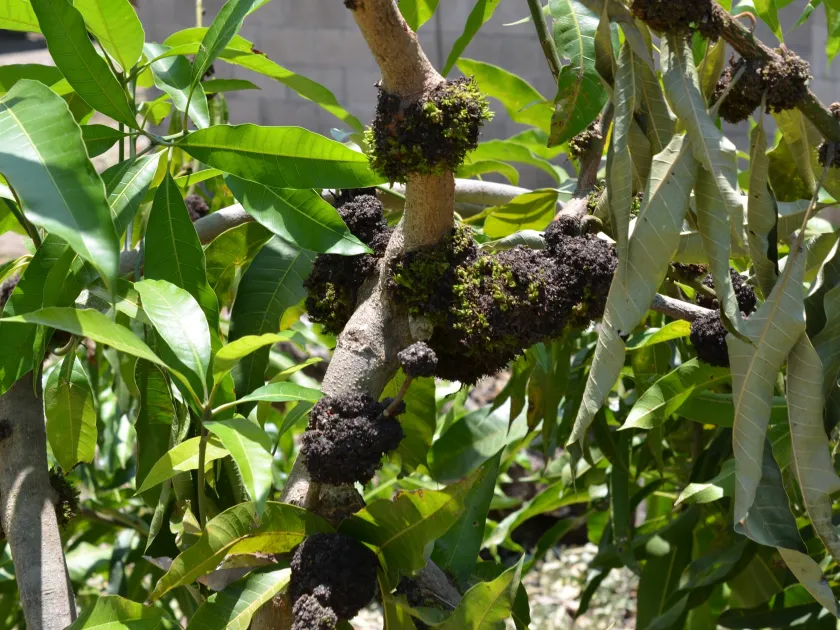
Feeding by the mites interferes with the tree's hormonal processes. This disruption causes the production of abnormal tissues and leads to the formation of galls, which significantly stunt the tree's development.
Floral tissues are the most severely impacted. Infested panicles often become shortened, thickened, and misshapen, rendering them incapable of proper pollination and leading to total crop failure on the affected branches.
Vegetative buds are also subject to severe infestation, which causes internode shortening and the development of dense, stunted "witch's broom" growths. These structures consume the plant's energy without providing any growth benefit.
Over time, persistent mite activity weakens the tree's overall vigor. Infested trees show reduced photosynthetic capacity and are more susceptible to additional biotic and abiotic stressors, leading to long-term decline in yield.
Signs of infestation
The most distinctive sign of infestation is the deformation of apical buds, which appear compact, swollen, and covered with hard scales. These formations are classic symptoms of mite-induced galling.
Shoot development is severely disrupted, showing a cluster of leaves and shortened stems that give the branch a bushy appearance. Leaves may exhibit chlorosis, curling, or overall reduction in size.
Floral panicles undergo significant hypertrophy. Instead of normal, extended inflorescences, the tree produces dense, green, cauliflower-like masses of tissue that never develop into fruit.
Microscopic examination of the affected bud scales will reveal thousands of individual mites and their eggs. Sticky residues and white, shed exoskeletons are also commonly found in and around the galls.
Advanced stages of infestation are characterized by the death of the terminal buds. This forces the tree to produce excessive side branches, resulting in a chaotic and unhealthy growth structure throughout the canopy.
Control measures
Sanitation is the cornerstone of management. Growers must prune and burn all malformed branches and buds to eliminate the reservoir of mites. Proper disposal is essential to prevent re-infestation.
Chemical control focuses on the use of acaricides. To be effective, spraying must be timed precisely with the periods of active mite migration, and systemic products are preferred to reach mites hidden deep inside the bud scales.
Integrated Pest Management (IPM) strategies, including the use of sulfur-based compounds, are recommended. However, growers should be cautious about phytotoxicity during high-temperature periods.
Quarantine and strict nursery hygiene are vital. All new mango seedlings must be inspected for signs of galling or bud swelling before being integrated into existing plantations.
- Regular monitoring of terminal buds during the pre-flowering season.
- Disinfecting pruning equipment with alcohol or chlorine solution after each tree.
- Promoting healthy tree growth through balanced fertilization to withstand damage.
- Removal of weeds that may serve as alternative hosts for mites.
Taxonomy
- Latin name
- Aceria mangiferae
- Order
- Mites
- Family
- Eriophyidae
- EPPO code
- ERPHMG
Discussion
No discussions yet — be the first.