
Maple gall mite
Aceria macrorhyncha
Description
How to identify
The maple gall mite (Aceria macrorhyncha) belongs to the Eriophyidae family, commonly known as gall mites. These are microscopic organisms with a worm-like, elongated body that is almost invisible to the naked eye.
The mite's life cycle is synchronized with the bud burst of the maple tree. Mites overwinter as adult females in bark crevices, bud scales, or protected areas along the branches.
In spring, as temperatures rise, mites migrate to the emerging foliage. By feeding on leaf cells, they inject substances that trigger the plant to produce galls, which serve as a specialized shelter and a source of nutrients for the mites.
Several generations are produced throughout the growing season. Warm, dry weather conditions significantly accelerate the life cycle, leading to a massive increase in the population density of the mites.
Dispersal primarily occurs via wind currents and phoresy, where mites attach themselves to larger insects or birds, allowing them to spread to neighboring trees in forests, parks, or residential areas.
What it damages
The maple gall mite primarily infests various species of the Acer genus, including the Norway maple. Young, tender leaves are the preferred target for the mite's feeding activity.
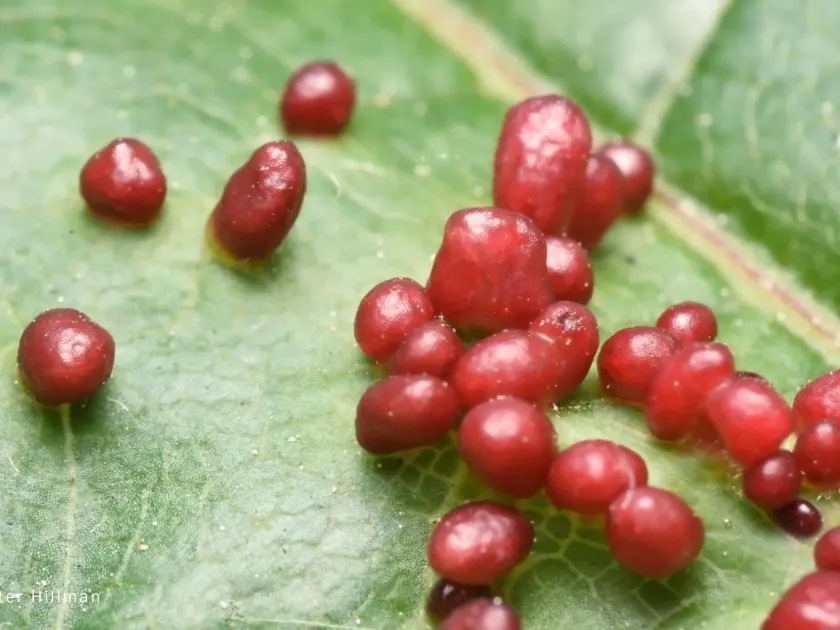
The formation of galls — abnormal growths on the leaf surface — is the primary symptom. These galls can vary in shape and color, often appearing as wart-like bumps that may range from green to reddish-brown.
Heavy infestations impair the tree's photosynthetic capability. Because the tree is forced to maintain these distorted gall structures, it experiences physiological stress, which can lead to premature leaf drop.
While the gall mite rarely kills a mature, healthy tree, it severely affects the aesthetic quality of landscaping maples. Repeated yearly damage can stunt the growth of young saplings and ornamental trees.
The damaged leaf tissue is also prone to secondary infections by various pathogens, including fungi that thrive in the weakened leaf cells, further complicating the tree's recovery process.
Signs of infestation
The initial signs of an infestation include the appearance of tiny, localized bumps on the upper surface of the leaves during the early spring as the buds open.
Under magnification, the undersides of these galls reveal small hollows where the mites aggregate. This can look like a light, dusty, or velvety layer on the underside of the leaves.
Affected leaves often show signs of distortion, such as rolling of the leaf margins or asymmetrical growth, which gives the canopy a ragged or unhealthy appearance.
Severe infestations manifest as widespread browning or yellowing of the foliage well before the autumn season, indicating that the tree is suffering from chronic stress due to the mite activity.
Monitoring the foliage in early summer is crucial for identifying the presence of galls before they become too widespread throughout the tree's canopy.
Control measures
Good sanitation is the first line of defense. Collecting and disposing of fallen leaves in autumn is essential, as this reduces the population of overwintering mites that would otherwise emerge in spring.
Chemical control involving acaricides can be effective, provided it is timed correctly. The most critical application window is during the spring bud burst when the mites are active and migrating to new foliage.
Systemic insecticides are often preferred over contact ones because the mites are protected inside the galls, making contact sprays less effective once the gall structure has fully formed.
Maintaining tree vigor through proper irrigation and fertilization helps the maple tree recover more quickly from mite damage and reduces its overall susceptibility to pests.
Encouraging natural predators such as lady beetles, lacewings, and predatory mites in the landscape can help keep the population of gall mites in check without relying on heavy chemical use.
Taxonomy
- Latin name
- Aceria macrorhyncha
- Order
- Mites
- Family
- Eriophyidae
- EPPO code
- ACEIMA
Discussion
No discussions yet — be the first.