
Litchi erinose mite
Aceria litchii
Description
How to identify
The Litchi erinose mite (Aceria litchii) is a microscopic eriophyid mite. It belongs to the order Trombidiformes and is a serious pest affecting litchi production worldwide.
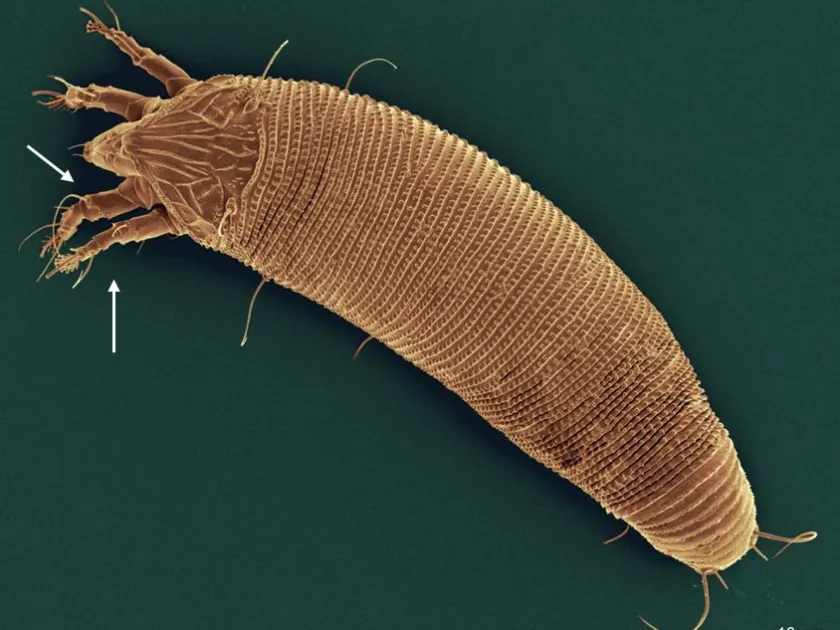
These mites are extremely small, reaching only about 0.15–0.2 mm in length. They are translucent to light yellow in color and have an elongated, worm-like body.
Unlike most mites, Aceria litchii has only two pairs of legs situated at the anterior end, which is a defining morphological feature of this family.
They complete their life cycle entirely on the host plant, moving from old leaves to fresh, young growth to establish new colonies as the tree produces new shoots.
The mites overwinter inside dormant buds and sheltered cracks in the bark, protecting them from environmental extremes and chemical treatments.
What it damages
The primary host for this pest is the litchi tree (Litchi chinensis). The mites feed on the underside of young leaves, causing a hypersensitive reaction.
This feeding behavior induces the plant to produce a dense, felt-like growth of trichomes, known as an erineum, which provides the mites with food and shelter.
Damage is not restricted to leaves; flowers and fruit stalks can also be attacked, leading to severe fruit drop and reduced quality of the harvested crop.
In cases of severe infestation, the tree's growth is stunted, and the loss of photosynthetic leaf area leads to a significant decline in tree vigor over time.
Young trees are particularly vulnerable, as repeated infestations can lead to total growth failure and potential death of the plant due to lack of energy reserves.
Signs of infestation
The most distinctive sign of an infestation is the appearance of brownish, velvet-like patches on the underside of the leaves, which start as small, light-colored spots.
Leaves affected by the mite become thick, distorted, and brittle. The curling of leaf edges is a standard visual symptom of the damage caused by the mite's feeding.
Inflorescences show signs of abnormal development or necrosis, preventing successful pollination and resulting in poor or non-existent fruit sets.
The erineum (the hairy growth) changes color over time, turning from white to light yellow, then brown or even black as the tissues begin to die.
Because the mites are hidden deep within the hair-like growths, they are often protected from surface-acting pesticides, making early detection crucial.
Control measures
Pruning is the most important cultural practice. Affected leaves and branches must be pruned and burned immediately to reduce the source of the mite population.
Chemical control focuses on applying acaricides at the time of new leaf growth, as this is when the mites are most exposed and active during their migration.
Rotating chemical classes is essential to prevent the development of resistance, which has been observed in populations of Aceria litchii in many growing regions.
Biological control using predatory mites (such as Phytoseiidae species) has shown promise in managing populations within established, sustainable orchards.
Integrated Pest Management (IPM) should be prioritized, combining strict sanitation, chemical intervention during critical windows, and regular monitoring of plant health.
Taxonomy
- Latin name
- Aceria litchii
- Order
- Mites
- Family
- Eriophyidae
- EPPO code
- ERPHLI
Discussion
No discussions yet — be the first.