
Pomegranate mite
Aceria granati
Description
How to identify
The pomegranate mite (Aceria granati) is a member of the Eriophyidae family, commonly known as gall or rust mites. These are microscopic, worm-like pests that are roughly 0.15 to 0.2 mm in length, making them invisible to the naked eye.
These mites have a rapid life cycle, which allows populations to explode under favorable conditions. They undergo development stages including egg, nymph, and adult, all occurring within the protective tissues or surfaces of the host plant.
Overwintering occurs primarily as fertilized females hiding within bud scales or deep in the crevices of the pomegranate tree's bark. When spring temperatures rise, these females migrate to fresh, developing tissues to begin feeding and egg-laying.
Dissemination throughout an orchard is passive, occurring via wind currents, insect vectors, or agricultural equipment. Because they are so small, they can easily travel across large distances unnoticed until symptoms manifest.
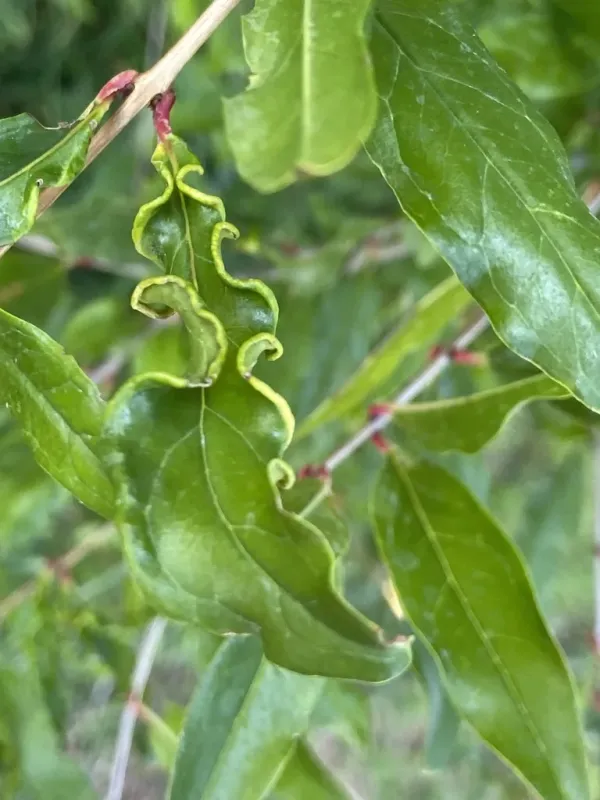
Identification in the field is rarely done by spotting the pest itself. Instead, agronomists rely on identifying the unique symptoms of injury, as the presence of this specific eriophyid mite produces distinct morphological changes in the plant tissue.
What it damages
The primary host is the pomegranate (Punica granatum). These mites feed on terminal buds, young leaves, and developing fruit. The piercing-sucking feeding mechanism leads to significant physiological stress and morphological distortion.
As the mite feeds, it injects salivary enzymes that trigger abnormal cell growth. This results in deformed leaves and stunted shoots. The loss of functional leaf area directly reduces the photosynthetic capacity of the tree, weakening it over the long term.
Fruit damage is the most critical economic concern. When mites attack young pomegranates, the skin develops cracks, corky patches, and scabbing. This ruins the fruit's marketability and makes it highly susceptible to secondary infections or rot.
Mass infestations often lead to flower abortion and the premature dropping of fruit. This can lead to a complete loss of harvest in severely affected orchards if mitigation steps are not taken early in the season.
Trees stressed by mite activity are also less vigorous, displaying reduced resistance to cold winter temperatures and other environmental stresses. This cumulative effect can degrade the productivity of an orchard over several consecutive years.
Signs of infestation
Early warning signs include the curling and twisting of young leaves in the spring. These leaves often appear stunted, thick, or chlorotic, which is a classic indicator of eriophyid mite activity disrupting normal growth patterns.
When fruit is infested, the surface develops a rough, russeted texture. As the fruit expands, these patches may crack, revealing underlying tissues. This russeting is a hallmark sign that the mite population has been active since the fruit set.
Under magnification, one might find colonies of mites within the dormant buds or beneath the leaf scales. However, the damage (such as localized necrotic spots or excessive hairiness of the tissue) is usually the first visible evidence of their presence.
Terminal shoot dieback is another indicator. If the growing point of a branch becomes heavily infested, it may stop elongating entirely and wither, which disrupts the tree’s branching structure and canopy development.
A decline in tree health accompanied by reduced flowering and fruiting cycles suggests an underlying pest issue. When these symptoms appear in patches across an orchard, it confirms the presence of an active infestation that needs to be addressed immediately.
Control measures
Chemical control is the most effective approach for large-scale management, utilizing specific acaricides. Treatments should be timed to target the mites during their emergence from overwintering sites, often requiring multiple applications.
Sanitation is a vital cultural practice. Pruning out infested branches and ensuring the disposal of clippings away from the orchard helps reduce the total population density and prevents the mite from surviving into the next season.
Biological control involves the use of predatory mites (such as Phytoseiidae species) that feed on eriophyids. Encouraging these beneficial predators can help maintain a natural balance in the orchard, reducing the need for chemical intervention.
Maintaining optimal tree vigor through balanced fertilization and proper irrigation helps the trees withstand mite damage. Stressed trees are always more susceptible to pest colonization and show slower recovery after treatment.
- Application of acaricides during the early spring bud-break.
- Strict sanitary pruning of all infested plant material.
- Promotion of predatory mite populations in the orchard.
- Regular monitoring of terminal shoots and developing fruit.
- Using balanced nitrogen-potassium levels to boost immunity.
Taxonomy
- Latin name
- Aceria granati
- Order
- Mites
- Family
- Eriophyidae
- EPPO code
- ACEIGA
Discussion
No discussions yet — be the first.