
Bermuda grass mite
Aceria cynodoniensis
Description
How to identify
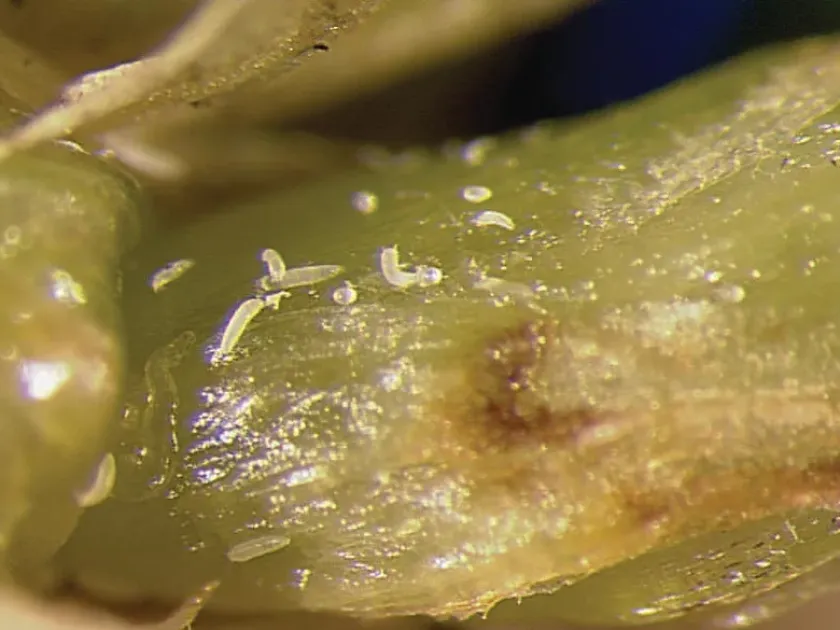
The Bermuda grass mite (Aceria cynodoniensis) is a member of the Eriophyidae family within the order Trombidiformes. These mites are microscopic, measuring approximately 0.2 mm in length, making them invisible to the naked eye.
They possess a worm-like body, typically white or translucent, which allows them to hide effectively within the leaf sheaths and buds of their host grass. They rely on wind currents for dispersal across turfgrass areas.
Their life cycle is highly specialized, occurring entirely on the host plant. They reproduce rapidly during warm weather, which allows populations to explode in a very short period under optimal conditions.
These pests cannot survive away from their host grass for extended periods. Their survival is dependent on the presence of green, actively growing plant tissues where they can feed and reproduce.
Identification often requires a hand lens or a microscope. An experienced agronomist can confirm the presence of mites by examining the deformed tissue taken from the growing points of the grass.
What it damages
The primary host for this mite is Bermuda grass (Cynodon dactylon). The damage is most frequently observed in managed turf environments, such as golf courses, sports fields, and high-end residential lawns.
Feeding occurs as the mites inject enzymes into the grass tissue. This biochemical interaction causes the host plant to produce abnormal growths, which are the primary indicator of mite activity.
Severe infestations lead to stunted growth and a general decline in turf vigor. The grass becomes thin, yellowed, and loses its capacity to recover from mowing or regular physical use.
The mite destroys the apical meristem of the grass blade, which prevents normal elongation. This results in the characteristic stunted, tufted appearance that degrades the aesthetic quality of the lawn.
In addition to direct physiological harm, infested turf is more susceptible to secondary environmental stresses, including heat, drought, and competition from invasive weed species.
Signs of infestation
The most iconic sign of infestation is known as "witches' broom." This occurs when the internodes of the grass stems become severely shortened, causing the leaves to cluster together in a tight, deformed tuft.
The affected patches appear stunted, pale, and visually distinct from the surrounding healthy turf. They do not respond to fertilization or irrigation, which often helps distinguish mite damage from nutritional issues.
- Extreme shortening of internodes
- Tufted, "fuzzy" appearance of grass tips
- Deformed and curled leaves
- Stunted growth rate compared to healthy areas
- Gradual yellowing and necrosis of the affected stems
Symptoms are usually progressive. As the infestation grows, the size and number of the "witches' brooms" increase, eventually causing the entire turfgrass stand to lose its uniformity.
Close inspection of the tufted areas with magnification will reveal the presence of numerous tiny mites hiding within the folded leaves and deep inside the bud clusters.
Control measures
Effective management begins with early detection. Regular scouting of the turf for signs of stunted growth or abnormal leaf development is essential for timely intervention.
Chemical control involving systemic acaricides is the standard approach. Applications must be thorough, ensuring that the chemical reaches the protected areas where the mites reside within the leaf sheaths.
Cultural practices play a major role in resistance. Proper fertilization, balanced irrigation, and healthy soil maintenance enable the grass to withstand moderate mite pressure better than stressed turf.
Mowing practices can help reduce mite populations. Lowering the mowing height and bagging the clippings can physically remove a large portion of the infested tissue from the field.
In cases of severe, persistent infestations, renovating the area and replanting with resistant cultivars of Bermuda grass may be the most effective long-term strategy for high-value turf areas.
Taxonomy
- Latin name
- Aceria cynodoniensis
- Order
- Mites
- Family
- Eriophyidae
- EPPO code
- ACEICY
Discussion
No discussions yet — be the first.