
Willow gall mite
Aceria caulicecis
Description
How to identify
The willow gall mite, known scientifically as Aceria caulicecis, is a tiny member of the Eriophyidae family. These microscopic pests have a worm-like body, usually measuring only about 0.2 mm in length, making them invisible to the naked eye.
Unlike most other mites, these creatures possess only two pairs of legs located at the front of their body. This specialized anatomy allows them to navigate within the narrow spaces of plant tissue.
The life cycle involves multiple stages within the galls. Adult females overwinter in bark crevices or under bud scales, emerging in early spring as temperatures rise to infest new leaves.
Their reproduction is remarkably fast, allowing multiple generations to occur during a single growing season. This high reproductive rate explains why infestations can spread rapidly across a single tree.
The mites are host-specific, primarily targeting species of willow (Salix). Their presence is almost exclusively linked to the formation of characteristic galls on the host plant.
What it damages
The willow gall mite feeds by sucking plant sap from young shoots and leaves. During feeding, the mite injects saliva, which contains growth-regulating substances that force the plant to create galls.
Galls serve as both a food source and a protective shelter for the mite colony. However, these structures divert nutrients away from the healthy development of the plant.
Severe infestations can lead to a significant decrease in the tree's photosynthetic capacity. This weakens the willow, causing stunted growth and poor aesthetic appearance.
Deformation of shoots is a common result of prolonged infestation. Affected branches become twisted, thickened, and brittle, which may eventually lead to dieback of the tips.
The overall stress caused by the mites makes the tree more susceptible to secondary environmental pressures and secondary infections by fungi or bacteria.
Signs of infestation
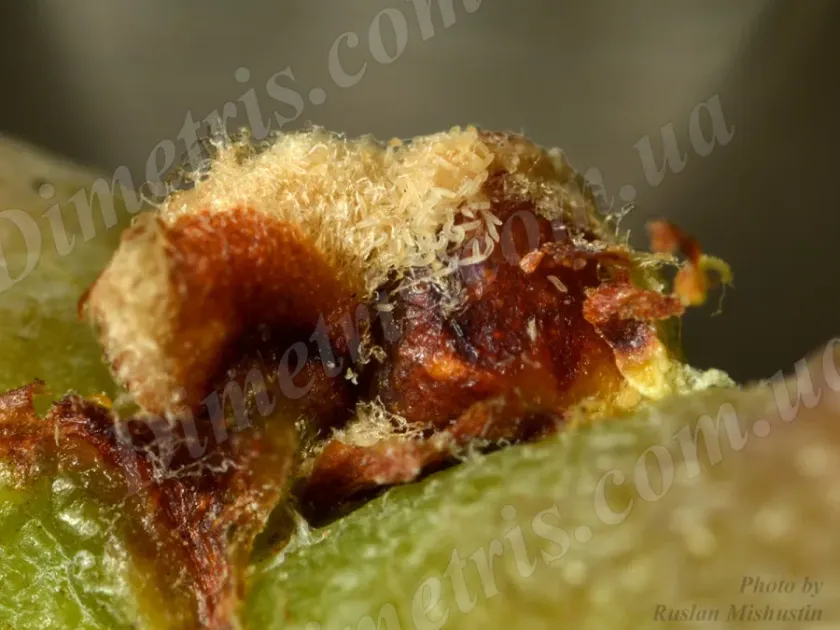
The most diagnostic sign of an infestation is the presence of galls—abnormal, knot-like growths on the foliage, petioles, or young stems of the willow.
These galls vary in appearance but are often characterized by raised, wart-like, or irregular swellings. The color can change from the healthy green of the leaf to yellow, red, or brown.
Affected shoots may appear distorted or show shortened internodes, giving the tree a stunted, crowded appearance in the infested areas.
If you break open a gall, you may find a colony of microscopic mites inside, often accompanied by some frass or debris, confirming the biological nature of the growth.
Early leaf drop in late summer, particularly in areas of the canopy heavily covered with galls, is a clear indicator that the plant is struggling with the pest load.
Control measures
Sanitation is the most critical first step. Regularly prune and destroy infested branches during the dormant season to physically remove the overwintering population.
A dormant oil spray or an appropriate acaricide applied before bud break in early spring can significantly reduce the number of emerging females.
During the growing season, systemic acaricides are preferred. Because the mites are protected inside the galls, contact sprays are often ineffective against mature colonies.
Maintaining tree vigor through proper watering and fertilization helps the willow withstand the stress induced by the mites and promotes faster recovery after pruning.
- Remove and burn infested branches annually.
- Apply sulfur-based sprays before bud break.
- Monitor trees regularly for the first signs of gall formation.
Taxonomy
- Latin name
- Aceria caulicecis
- Order
- Mites
- Family
- Eriophyidae
- EPPO code
- ACEICU
Discussion
No discussions yet — be the first.