
Pecan leaf gall mite
Aceria caryae
Description
How to identify
The pecan leaf gall mite (Aceria caryae) is a microscopic pest belonging to the Eriophyidae family. These tiny organisms are worm-like in shape, measuring approximately 0.2 mm in length, making them invisible to the naked eye.
Unlike most mites, these individuals possess only two pairs of legs located at the anterior part of their body. They are typically translucent to yellowish-white in coloration.
The life cycle of Aceria caryae is strictly tied to the host plant. They spend the winter as adult females, tucked away in dormant buds or under the protective bark scales of the tree branches.
Activity resumes in early spring when the mites move to the developing leaves to feed. Their feeding action triggers the formation of specialized structures on the leaves.
Due to their minute size and hidden lifestyle, detection is primarily based on the appearance of characteristic plant malformations rather than finding the mites themselves.
What it damages
This mite species primarily targets walnut and pecan trees. The damage is restricted to the leaf foliage, where the mites establish their feeding colonies.
As the mites feed, they secrete substances that cause the leaf tissue to develop abnormal growths known as galls. These galls provide the mites with a nutrient-rich and protected environment.
Heavy infestations can lead to significant leaf distortion, which impairs the plant's photosynthetic efficiency. This often results in premature leaf drop and overall physiological stress.
While the galls are mostly aesthetic in mild cases, severe outbreaks can impact the tree's vigor and potentially reduce the quality and quantity of the nut yield over time.
In addition to physical damage, the presence of galls can make the leaves more susceptible to secondary fungal infections due to the weakened state of the leaf tissue.
When it appears
The activity of the pecan leaf gall mite begins in early spring, synchronized with the bud-break phenology of the host tree. Mites emerge from their overwintering sites as temperatures rise.
During the growing season, multiple generations can occur. Summer months provide ideal conditions for population buildup within the leaf galls, where moisture levels remain optimal.
Dry and warm weather conditions are often correlated with rapid population cycles, as the galls protect the mites from environmental extremes and natural predators.
As autumn approaches and the tree prepares for winter dormancy, the adult mites migrate back from the leaves to the buds and bark to secure overwintering sites.
Effective management requires targeting the mites during their migration or early colonization phase, before they are safely enclosed within the protective gall structures.
Signs of infestation
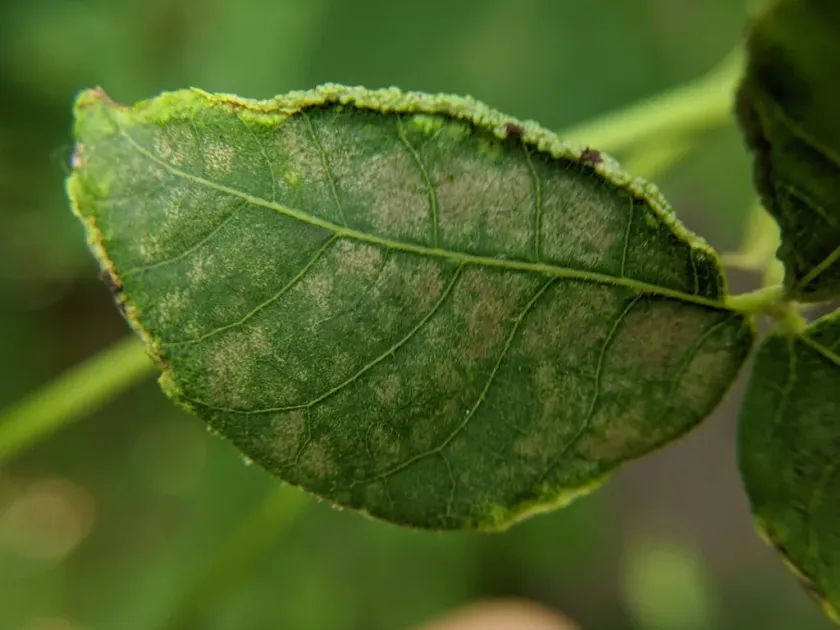
The primary sign of infestation is the formation of numerous tiny, raised growths or galls on the leaf surface. These are often concentrated near the midribs or main veins.
Initial galls appear as light green or yellowish spots. As they mature, they often turn reddish or brown, creating a distinct bumpy texture on the upper side of the foliage.
The underside of the leaf, corresponding to the gall position, typically features a dense mat of hair, known as an erineum, which serves as a protective layer for the mites.
Leaf curling and significant distortion of the leaf blade are common indicators in trees with high mite populations. The foliage may appear puckered or stunted.
Visual inspection with a hand lens will reveal the presence of tiny, mobile organisms within the erineum on the lower leaf surface, confirming the pest presence.
Control measures
Controlling this mite is challenging because the gall structure effectively shields the colony from standard contact-based chemical treatments.
Systemic acaricides that can be absorbed into the leaf tissues are the most effective solution, as they reach the mites through the sap of the plant.
Treatment should be applied early in the season, during the bud-burst stage, when mites are actively moving but before the galls have completely enclosed them.
- Applying sulfur-based dormant sprays in early spring;
- Using systemic acaricides at the first signs of leaf emergence;
- Pruning and destroying heavily infested branches during winter;
- Implementing proper irrigation and fertilization to maintain overall tree vigor.
Rotating chemical classes is essential to manage the population and prevent the development of pesticide resistance in the mite population.
Taxonomy
- Latin name
- Aceria caryae
- Order
- Mites
- Family
- Eriophyidae
- EPPO code
- ACEICR
Discussion
No discussions yet — be the first.