
Pigeon pea mite
Aceria cajani
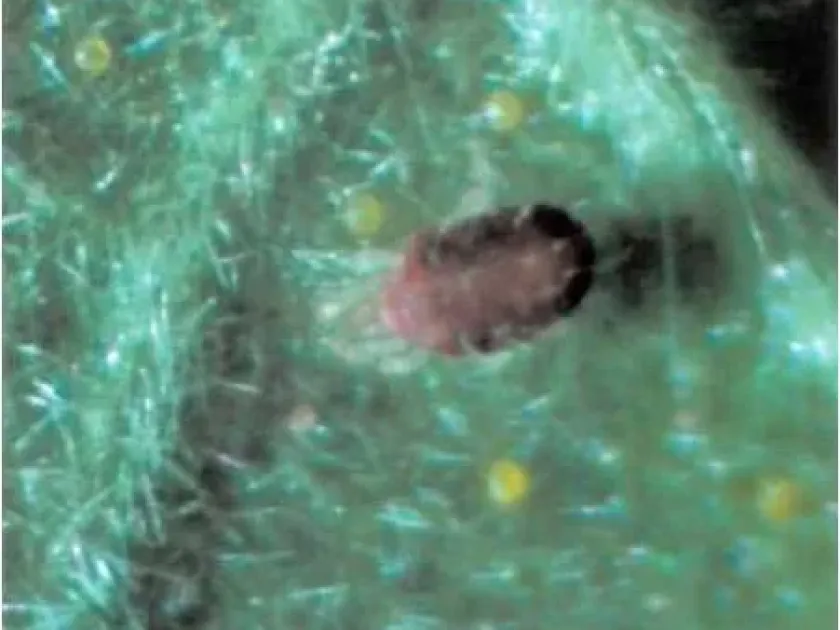
Description
How to identify
The pigeon pea mite Aceria cajani is a microscopic arthropod belonging to the family Eriophyidae. These mites are extremely small, with adults measuring approximately 0.2 mm in length, making them invisible to the naked eye.
They possess an elongated, worm-like body, typically translucent or light yellow in color, which allows them to blend in perfectly with the leaf tissues and buds of their host plant.
This mite is a highly specialized pest that thrives in warm, humid conditions. It spends its entire life cycle on the host plant, concentrating in protected areas like axils and developing buds.
The life cycle is rapid, often completing within 7 to 10 days, which leads to exponential population growth during the optimal growing season for pigeon peas.
Overwintering occurs primarily in the adult female stage, hiding deep within plant buds or under the bark, which allows the species to survive adverse environmental conditions.
What it damages
The primary host of Aceria cajani is the pigeon pea (Cajanus cajan). The mite itself causes minor physical damage through feeding, but its main impact is biological and economic.
The mite is the sole vector of the Pigeon Pea Sterility Mosaic Virus (PPSMV), a devastating pathogen that can cause complete crop failure in susceptible cultivars.
As the mites feed on the sap of young leaves and shoots, they facilitate the entry and transmission of the viral particles into the plant's vascular system.
The resulting infection prevents normal flowering and pod formation, leading to sterility where the plant becomes completely unproductive despite having a leafy, green appearance.
Economic losses caused by this mite-virus complex are significant, often requiring total removal of infected plants to prevent the spread of the disease across the field.
Signs of infestation
Initial signs of infestation include tiny, chlorotic spots on the leaves, which may progressively become mosaic-like in pattern as the virus spreads throughout the plant.
Leaves on infected plants may appear stunted, curled, or distorted, often showing a darker green or mottled yellow coloration compared to healthy foliage.
A hallmark sign of the infection transmitted by this mite is the total absence of flowers or the presence of malformed, non-viable flower buds.
Infected plants often develop a bushy, stunted appearance, characterized by the proliferation of numerous small, brittle branches, commonly referred to as a witches' broom symptom.
Field-level diagnosis is usually based on the cluster distribution of plants showing reduced growth and sterilization, which spreads along the direction of wind currents.
Control measures
The most sustainable management strategy is the use of pigeon pea cultivars that have been bred for genetic resistance to the sterility mosaic virus.
Cultural practices, such as maintaining a host-free period by removing crop debris and volunteer plants, are essential to break the mite's life cycle.
Implementing strict quarantine and spatial isolation between newly planted fields and older, infected crop areas helps to limit the movement of mites.
Chemical control with acaricides can be effective, but it must be applied during the early stages of infestation to prevent the colonization of buds where the mites are difficult to reach.
Early detection through systematic monitoring of fields allows for the prompt roguing of infected plants, which significantly reduces the potential for wider virus transmission.
Taxonomy
- Latin name
- Aceria cajani
- Order
- Mites
- Family
- Eriophyidae
- EPPO code
- ACEICJ
Discussion
No discussions yet — be the first.