
Eriophyid mites
Aceria
Description
How to identify
Eriophyid mites, belonging to the family Eriophyidae, are minute, worm-like arthropods that are barely visible to the naked eye. Adults typically measure between 0.1 and 0.3 mm in length, making field identification challenging.
Unlike most mites that have four pairs of legs, Eriophyid mites possess only two pairs of legs, which are located at the front of their elongated, ringed body. This distinct anatomical feature is a key identification marker under a microscope.
They are usually pale, translucent, or yellow in color. Because they lack a hard exoskeleton and are extremely small, they thrive in protected environments like leaf galls, buds, or curled foliage, where they remain sheltered from predators.
Systematically, they fall under the order Trombidiformes. These mites are highly host-specific, meaning that a single species of Aceria often restricts its infestation to one or very few plant species, simplifying the diagnostic process once the host is known.
Eriophyid mites do not produce webs, which helps distinguish them from spider mites. Their presence is revealed primarily through the specific, often dramatic, physical symptoms they induce in the host plant.
What it damages
These mites are significant agricultural pests that cause widespread damage to fruit trees, vegetables, and ornamentals. They feed by inserting their stylets into plant cells to extract sap, which triggers abnormal hormonal and structural responses.
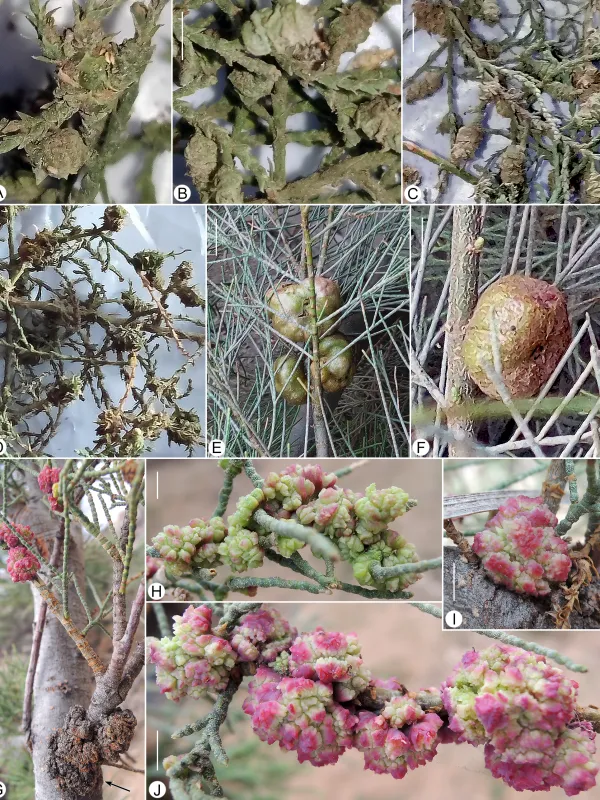
The most common form of damage is the formation of galls—abnormal outgrowths of plant tissue. These can take the form of blisters, pouches, or dense masses of hairs on leaves, often creating a protective environment for the colony.
Damage to apical buds frequently causes stunted growth, distorted stems, and the "witches' broom" effect, where many weak, crowded shoots grow from a single point. This significantly reduces the vigor and yields of the crop.
Furthermore, Eriophyid mites are efficient vectors for several plant viruses and phytoplasmas. By moving from plant to plant, they transmit diseases that can be more devastating than the direct damage caused by their feeding.
The resulting economic impact includes loss of fruit quality, disfigurement of decorative plants, and a general decline in plant health, making them a major concern for commercial growers and home gardeners alike.
When it appears
Adult females typically overwinter in protected spots, such as crevices in bark, under bud scales, or in the protected leaf scars of the host plant. They emerge as soon as temperatures rise in the early spring.
These mites are capable of producing multiple generations throughout the growing season, often completing a full life cycle in just a few weeks under favorable weather conditions, typically warm and humid climates.
Dispersal occurs passively. Mites are picked up by the wind, rain, or are transported by birds and insects. In an orchard or garden setting, they are frequently spread by human activity, including pruning and handling of infected materials.
As daylight hours decrease and temperatures drop in the autumn, the population begins to migrate to overwintering sites. This is a critical period for management, as the mites are once again concentrated and vulnerable on the plant surface.
Monitoring for signs of activity must be constant throughout the spring and early summer, as the mites are most active during the rapid growth phase of their host plants.
Signs of infestation
The most telltale sign of an infestation is the appearance of galls—localized swellings or abnormal growths on leaves, flowers, or stems. These galls often turn from green to yellow, red, or brown as they mature.
Leaf curling, crinkling, and mosaic-like discoloration are common indicators. Severely infested leaves may become brittle, malformed, and eventually drop prematurely, impacting the plant's ability to photosynthesize.
Affected fruit often develops a corky or russeted surface texture, reducing its market value. In some cases, such as in tomatoes or grapes, the damage can render the fruit entirely unsalable due to severe deformity.
Bud development can also be severely disrupted, resulting in failure of buds to open or the production of weak, stunted foliage that emerges in clusters.
- Formation of leaf galls or blister-like swellings
- Distorted, curled, or crinkled leaf margins
- Stunted shoot growth and malformed buds
- Russeting or corky skin on fruits
- Yellowing or chlorotic patches on foliage
Control measures
Chemical control focuses on the use of systemic or contact acaricides. Because these mites live inside plant tissues, timing is crucial; applications must be made before the mites enter the safety of galls or buds.
Sulfur-based sprays are a standard and highly effective treatment, particularly in early spring. They act as both an acaricide and a fungicide, providing dual protection during the critical bud-break phase.
Cultural practices play a major role in management. Pruning and destroying infected branches can significantly reduce the overwintering population. Disinfecting pruning tools between trees is vital to prevent spreading the infestation.
Biological control, utilizing predatory mites (such as Phytoseiidae species), is an excellent strategy in Integrated Pest Management (IPM) programs, effectively suppressing Eriophyid mite numbers without relying heavily on chemical inputs.
Maintaining vigorous plant health through proper fertilization and irrigation helps plants tolerate light infestations, while choosing resistant varieties remains the most sustainable long-term solution for problematic sites.
Taxonomy
- Latin name
- Aceria
- Order
- Mites
- Family
- Eriophyidae
- EPPO code
- ACEISP
Discussion
No discussions yet — be the first.