
Blackberry mite
Acalitus essigi
Description
How to identify
The blackberry mite (Acalitus essigi) is a microscopic pest belonging to the family Eriophyidae (gall mites) within the order Acariformes.
These mites are extremely small, measuring approximately 0.15–0.2 mm in length, making them invisible to the naked eye under field conditions.
They possess a worm-like, elongate body with a whitish or translucent appearance, and they move across the plant surface using two pairs of legs.
As highly specialized parasites, they live primarily inside the flowers and developing fruitlets of the blackberry plant.
Because they spend most of their life cycle hidden within the berry drupelets, they often go unnoticed until the damage becomes visually apparent.
What it damages
The primary host for this pest is the blackberry, although it can occasionally infest other Rubus species, including raspberries.
The mite feeds by inserting its mouthparts into the plant tissues and injecting saliva that contains enzymes, which disrupts the normal development of the fruit.
This feeding mechanism prevents the drupelets from ripening properly, causing the fruit to remain hard, sour, and unevenly colored.
Heavy infestations can ruin nearly the entire crop, rendering the berries unmarketable as they fail to soften or turn dark upon reaching maturity.
Besides immediate crop loss, persistent feeding weakens the plant, potentially reducing its overall vigor and productivity for subsequent growing seasons.
When it appears
The life cycle of the blackberry mite is tightly synchronized with the phenology of the host plant, starting with the awakening of buds in early spring.
Fertilized females overwinter in protected sites such as bud scales, leaf axils, or cracks in the bark of the blackberry canes.
As temperatures rise, the mites migrate to the newly forming buds and eventually to the open flowers, where they begin to reproduce rapidly.
Multiple generations occur throughout the growing season, with the population density peaking during the time of fruit maturation.
As autumn approaches and the plant enters dormancy, the mites move to their overwintering locations to survive the winter temperatures.
Signs of infestation
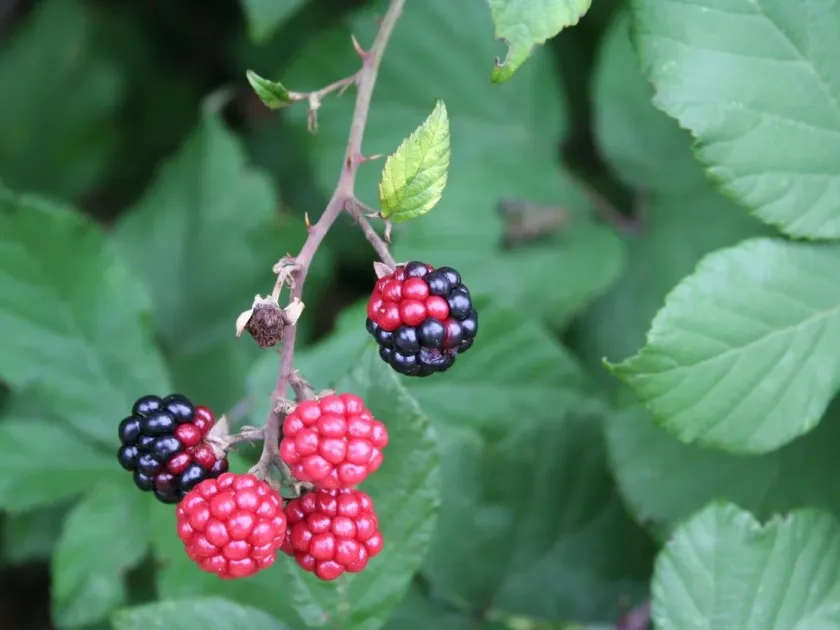
The most distinctive sign of infestation is known as "redberry disease," where drupelets fail to turn black at maturity.
Affected fruit remains firm, hard, and often exhibits a bright red or greenish-red color, regardless of its chronological stage of development.
Berries appear distorted, bumpy, and irregular, as the individual drupelets do not expand or soften as they should.
These hardened berries are sour, unpalatable, and have a woody texture, making them completely unsuitable for fresh consumption or processing.
- Uneven coloration of berries (red or green spots).
- Fruit remaining unnaturally hard when squeezed.
- Distorted and stunted drupelets on the ripened cluster.
Control measures
The first line of defense is ensuring the use of certified, mite-free nursery stock to prevent introducing the pest into the plantation.
Sanitation practices, such as pruning and destroying old, post-harvest canes, are crucial to reduce the overwintering population of the mites.
Chemical control must be applied early, specifically before the bloom period, to target the mites while they are exposed on the buds.
Once the flowers open and berries begin to form, the mites are protected inside the fruit, making them extremely difficult to reach with conventional acaricides.
If an infestation is detected, infected canes and berries should be removed and disposed of away from the field to limit the spread of the population.
Taxonomy
- Latin name
- Acalitus essigi
- Order
- Mites
- Family
- Eriophyidae
- EPPO code
- ACEIES
Discussion
No discussions yet — be the first.