
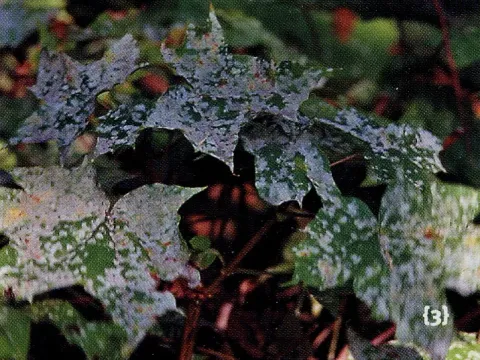
Alder powdery mildew
Microsphaera alni
The causative agent of the disease is a specialized ascomycete fungus Microsphaera alni, belonging to the order Erysiphales. This phytopathogen parasitizes primarily on the surface of the host plant tissues, using haustoria — specialized mycelial outgrowths that penetrate epidermal leaf cells — for nutrition.
What the section contains
Alder powdery mildew
The fungus mycelium develops superficially, forming a characteristic whitish or grayish coating. During its development, the pathogen forms conidial sporulation, which ensures rapid infection spread during the growing season, and cleistothecia — fruiting bodies for overwintering.
The life cycle of the fungus includes both sexual and asexual stages. In spring, ascospores from overwintered fruiting bodies are dispersed by wind to infect young leaves. During the summer, mass reproduction occurs via asexual spores (conidia), leading to disease outbreaks.
The fungus prefers moderately warm and humid weather, although strong fluctuations in air humidity often provoke active mycelial growth. Optimal conditions for spore germination are created at temperatures between 18 and 25 degrees Celsius.
The biology of Microsphaera alni is closely linked to the condition of the alder leaf blade. The infection more frequently affects weakened trees growing in dense stands with poor ventilation and insufficient light reaching the crown.
The main targets of infestation are grey alder and black alder. The pathogen is capable of affecting leaves, young shoots, and petioles, causing premature wilting and leaf fall, which significantly reduces the plant's decorative value and vitality.
Infested leaves become deformed, their edges may curl, and the surface is covered with a dense layer of mycelium, which disrupts the photosynthesis process. In severe cases, necrotic processes lead to the death of young growth.
In young alder seedlings, powdery mildew causes pronounced growth retardation. Constant infestation over several seasons weakens the tree's immune system, making it vulnerable to secondary infections and pests.
In forest stands, mass infestation with powdery mildew negatively affects wood increment and the accumulation of nutrients in the root system before winter. This is particularly relevant for young forest plantations in nurseries.
Although the disease rarely leads to the death of a mature tree, it significantly lowers the overall biological resistance of alder stands to adverse climatic factors and anthropogenic impacts.
The first sign of infection is the appearance of individual white spots of spider-web-like coating on the upper, and sometimes lower, side of the leaves. Gradually, this coating becomes powdery and expands, covering the entire leaf blade.
By mid-to-late summer, numerous small dots appear in areas of mycelium accumulation — the fungal fruiting bodies (cleistothecia). Initially, they have a yellowish or brownish color, and as they mature, they turn almost black.
Leaves affected by the pathogen lose their natural green color, turn yellow, and may drop prematurely. In the affected areas, the epidermis often acquires a brown shade due to cell death caused by fungal toxins.
Severe shoot infestation leads to their curling and the cessation of longitudinal growth. The coating on young branches can be denser, resembling a felt-like structure, which protects the mycelium from external influences.
When examining leaves from an infected tree, it is easy to notice the difference between the powdery mildew coating and the plant's natural waxy layer: the mycelium rubs off upon contact and has a specific granular structure under a magnifying glass.
The basis of control is the agrotechnical method: timely removal and destruction of fallen leaves, where the fungus fruiting bodies are preserved. It is important to thin out dense plantings to improve air circulation.
In cases of significant infestation, chemical protection agents are used. The use of systemic fungicides based on triazoles or strobilurins is effective, as they suppress mycelial development and prevent spore formation.
Treatments with sulfur-based preparations in the early growing season show good results. Sulfur has both prophylactic and curative effects, creating an environment unfavorable for spore germination.
- Prophylactic treatments during the bud burst period.
- Repeated spraying at 10–14 day intervals under conditions favorable for the fungus.
- Balanced fertilization (avoiding excess nitrogen that provokes the growth of tender tissue).
- Stimulation of plant immunity using biological preparations.
An important component of protection is the use of resistant alder species and cultivars in landscaping. Continuous phytosanitary monitoring of tree conditions allows for early infection detection and prevents epiphytotic spread.