
Anthracnose of cucurbits
Glomerella lagenaria
Anthracnose of cucurbits, caused by the fungal pathogen Colletotrichum orbiculare (formerly Glomerella lagenaria), is a devastating disease affecting various members of the Cucurbitaceae family.
What the section contains
Anthracnose of cucurbits
The pathogen belongs to the Ascomycota phylum and is classified as a facultative parasite capable of surviving on crop debris and soil.
The fungus produces conidia within acervuli, which appear as small, dark, cushion-like structures that break through the host tissue surface.
The systematic position of this organism places it in the order Glomerellales, known for causing significant damage to horticultural crops worldwide.
The fungal life cycle involves rapid spread via splashing water, which allows the conidia to infect new leaves, stems, and fruits during wet conditions.
This pathogen impacts a wide range of hosts, including cucumbers, zucchini, pumpkins, watermelons, and cantaloupes, causing significant yield losses.
Infection results in the destruction of photosynthetic leaf area and stem integrity, leading to the collapse and death of infected plants.
Fruit damage is particularly severe as it manifests in deep, water-soaked lesions that compromise the structural integrity and marketability of the produce.
Contaminated fields may see severe epidemic outbreaks, especially in monocultures where host plants are planted at high densities.
Post-harvest losses are also significant, as fruits infected during the growing season often develop rot during storage and transit.
Anthracnose typically emerges during the mid-to-late growing season when temperatures are warm and atmospheric humidity levels rise.
The disease development is most aggressive when frequent rainfall is combined with high temperatures, creating a perfect environment for sporulation.
The optimal thermal window for the fungus to germinate and colonize host tissues ranges from 22 to 27 degrees Celsius.
In greenhouse conditions, the disease spreads most effectively when irrigation leads to standing water and poor air circulation within the structure.
Dew formation on leaves during morning hours often serves as the primary moisture source for the initiation of new infection cycles.
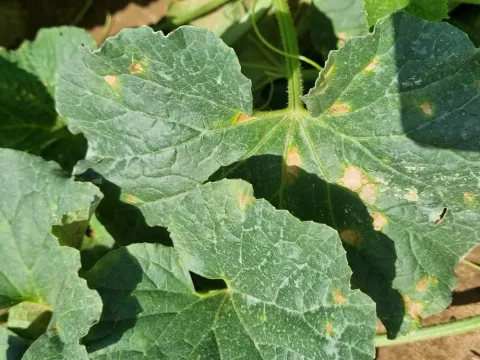
Early symptoms include small, yellow, water-soaked spots on leaves that eventually turn brown or black with a distinct yellow halo.
Stem lesions appear as elongated, sunken dark areas that can eventually girdle the vine, leading to rapid wilting of the distal parts of the plant.
Fruit symptoms are characterized by deep, circular pits that often ooze a pink or orange mass of fungal spores under high humidity.
As the disease progresses, leaves may become shredded due to the drying out of necrotic tissues, leaving characteristic shot-holes.
- Circular necrotic leaf spots with halos.
- Sunken lesions on stems and petioles.
- Deep pits on fruits with pink sporulation.
- Premature defoliation and plant wilting.
Effective management starts with crop rotation, ensuring a period of at least three years between planting cucurbits in the same field.
The use of certified, disease-free seed is essential to prevent the primary introduction of the pathogen into new growing areas.
Fungicide applications, including protective copper-based sprays or systemic triazoles, are crucial when environmental conditions favor the disease.
Good sanitation practices, such as the complete removal or deep incorporation of plant debris after harvest, significantly reduce the primary inoculum load.
Optimizing irrigation methods, specifically shifting to drip irrigation to keep foliage dry, is highly effective in curbing the spread of the disease.