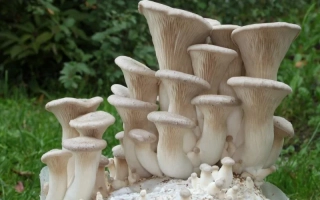
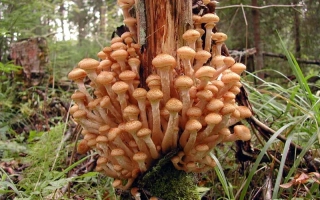
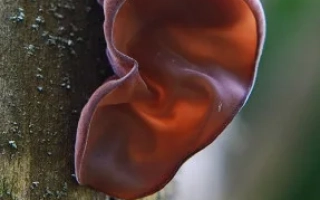
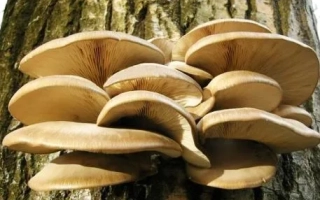
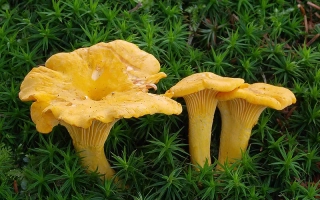
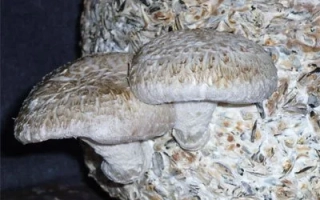
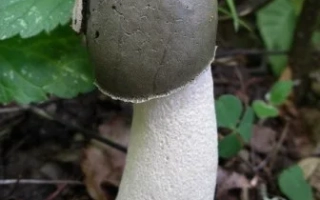
Japanese Oyster Mushroom sticks are edible mushrooms belonging to the family Pleurotaceae. The fruiting body is cap-stemmed, central or slightly eccentric. The cap is 2-10 cm, flat (convex in young specimens), yellow, honey-brown, or orange-brown. The cap edges are usually lighter than the center. The flesh is thin, from white to pale yellow, with a pleasant taste. The stem is 2-7 cm × 0.3-1 cm, cylindrical, firm, characteristic velvety-brown, reddish-brown at the top. Gills are attached, sparse, with some shortened gills. Color ranges from white to ochre. Remnants of the veil are absent. Spore powder is white.
Fruiting in dense clusters, often fused. Common in the northern temperate zone. Season: autumn to spring. Continues to fruit during winter thaws, often found under snow.
Edible mushroom (category 4). Used fresh (boiled for about 20 minutes), pickled, and salted. Young specimens have the dark stem base removed; older ones are collected only for caps. Boiled specimens remain slippery, which not everyone likes. Tolerates freezing well, retaining flavor, so can be harvested frozen and thawed. Especially popular in Japanese cuisine.
Scientists have found that winter oyster mushroom produces flammulin — a substance active against sarcoma.
Cultivated in Japan, Korea, and other countries on an industrial scale. Specialized moist wood (50-70% moisture) or wheat straw is used as substrate. Harvest is obtained almost year-round. Global production — up to 100,000 tons per year.
Cultivation of Japanese Oyster Mushroom
Only deciduous wood logs, free from rot signs, harvested 1-4 months before inoculation, are used. One package (10 sticks) is designed for logs no longer than 30 cm and up to 15 cm in diameter. Before inoculation, logs should be soaked in water for 2-3 days, then excess water should be drained over a day.
In prepared logs, drill holes in a checkerboard pattern, 5-6 cm deep, 1 cm diameter, 10-15 cm apart. Insert sticks by hand and cover holes with bark pieces, paraffin, moist cotton, etc. After wrapping in polyethylene film, make small ventilation holes, and place in a dark, humid location for mycelium colonization.
Under favorable conditions, t=20-25°C and 80-90% humidity, logs colonize within 2-3 months. When white growth appears at infection sites and log ends, remove the film and vertically bury logs into soil to two-thirds of their length, placing moist leaves or straw at the bottom of the pit. Outdoors, choose a shaded, wind-protected area. Indoors, plant in pots or containers with soil; suitable locations are unheated rooms where optimal conditions can be created. Care involves watering the planting site with a spray 2-3 times per week, daily during fruiting phase.
Under favorable conditions, mushrooms fruit in waves several times a year, depending on wood density, fruiting lasts 3-7 years. Yield is 15-30% of wood mass and depends on climatic conditions. If planted in summer or autumn, fruiting occurs the following year. Inoculation of wood indoors is performed year-round, while planting into soil occurs from April to October.