

SKU #73607
·
58 views
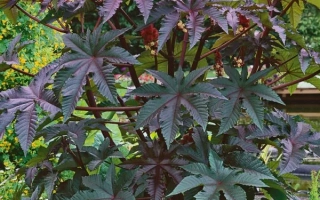
DONSKAYA LARGE-LEAVED CASTOR
Castor Bean
User rating
0 votes0% positive reviews
No ratings yet — be the first.
Assignment
Technical oil
Registration year
1977
About product

Donskaya large-leaved castor bean – a mid-season variety with a vegetation period of 110–120 days and high technological efficiency due to single-stem growth and partial leaf drop during maturation. Plants are of medium height, weakly branched, with stems and leaf petioles colored purple-light gray with a waxy coating, indicating a good level of protection against pests.The yield of the variety fl…
Assignment
Technical oil
Registration year
1977
Description
Donskaya large-leaved castor bean – a mid-season variety with a vegetation period of 110–120 days and high technological efficiency due to single-stem growth and partial leaf drop during maturation. Plants are of medium height, weakly branched, with stems and leaf petioles colored purple-light gray with a waxy coating, indicating a good level of protection against pests.
The yield of the variety fluctuates within the range of 2.4–2.5 t/ha, while the oil content of the seeds reaches 54–56%. The mass of 1000 seeds is approximately 310–330 g. These indicators make the variety attractive for commercial oil and feed production.
Donskaya large-leaved castor bean is well adapted to a wide range of climatic zones: from northern to far-eastern regions, including central, Ural, and Siberian territories. The variety is resistant to fusarium wilt and pests, which reduces the need for agrochemical control. At sowing, the optimal depth is 7–8 cm when the soil temperature reaches 14–16 °C; deviations from these parameters lead to a noticeable loss of yield.
The variety was included in the state register, but its distribution was discontinued due to the expiration of the exclusive right to the breeding achievement. Nevertheless, Donskaya large-leaved castor bean remains a valuable material for research and potential use in new breeding programs.
The yield of the variety fluctuates within the range of 2.4–2.5 t/ha, while the oil content of the seeds reaches 54–56%. The mass of 1000 seeds is approximately 310–330 g. These indicators make the variety attractive for commercial oil and feed production.
Donskaya large-leaved castor bean is well adapted to a wide range of climatic zones: from northern to far-eastern regions, including central, Ural, and Siberian territories. The variety is resistant to fusarium wilt and pests, which reduces the need for agrochemical control. At sowing, the optimal depth is 7–8 cm when the soil temperature reaches 14–16 °C; deviations from these parameters lead to a noticeable loss of yield.
The variety was included in the state register, but its distribution was discontinued due to the expiration of the exclusive right to the breeding achievement. Nevertheless, Donskaya large-leaved castor bean remains a valuable material for research and potential use in new breeding programs.
Crop & resistance
Crop
Disease resistance
Specifications
| Assignment | |
|---|---|
| Registration year | 1977 |
| Catalog | Catalog → Castor Bean |
| Legal data |
Show · 6
|
| Country | Russia |
Store offers
Prices are updated on loadLoading offers…
Aggregator catalog: prices are collected automatically from store websites, normalized by AI and converted at the current exchange rate. Before ordering, confirm the price and availability on the store's website. This block is not indexed by search engines — the data is loaded after the page opens.
Not yet комментариев. Be the first!
Alternatives
Castor Bean · similar varieties



See also
Often considered together with this variety




Recently viewed
Products you’ve viewed on this site
Reviews · 0