
Groundnut rosette virus
Umbravirus arachidis
The disease is caused by the Groundnut rosette virus (GRV), a member of the Umbravirus genus, which requires a helper virus to complete its infection cycle.
What the section contains
Groundnut rosette virus
This virus relies on the Groundnut rosette assistor virus (GRAV), a luteovirus, to provide the capsid proteins necessary for the virus to move and replicate within the host plant.
The transmission of the virus is strictly biological, occurring through the feeding activity of the groundnut aphid, Aphis craccivora.
The pathogen persists in various wild legume species and perennial plants, which serve as reservoirs that carry the virus throughout the year.
The interaction between the two viruses is complex, as they must both be present in the plant cells for the characteristic symptoms of rosette disease to appear.
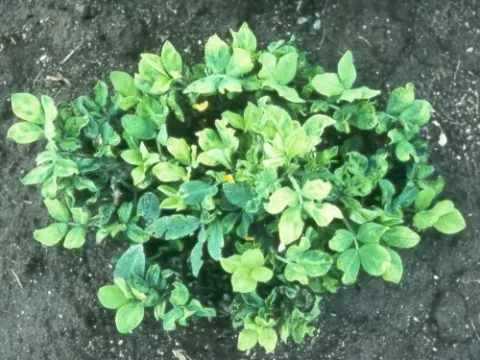
Initial symptoms are characterized by chlorotic mottle and mosaic patterns appearing on young leaflets shortly after emergence.
A distinctive feature of the disease is the extreme shortening of internodes, causing the plant to grow in a stunted, compact, and rosette-like habit.
Leaves become significantly distorted, curled, and smaller in size, often exhibiting a yellowish or pale green discoloration due to chlorophyll disruption.
Infected plants show suppressed development and cease vertical growth, while excessive branching leads to a dense, shrub-like appearance.
- Chlorotic mosaic and mottling of new leaves.
- Severe stunting and shortened internodes.
- Leaf curling and deformation.
- Total failure to produce flowers or pods in severe cases.
Disease outbreaks are heavily influenced by environmental conditions that favor the population growth and migration of the aphid vector, Aphis craccivora.
Periods of dry weather followed by rain often trigger the migration of aphids from wild host reservoirs into peanut fields, leading to widespread infection.
Optimal temperatures for viral replication within the host tissue generally range between 20°C and 28°C, which aligns with peak aphid activity.
High planting densities without proper isolation from previously infected fields increase the risk of rapid disease transmission across the plantation.
Poor sanitation practices, such as allowing weed growth around fields, provide a continuous bridge for the virus to survive and spread during the growing season.
Groundnut rosette is recognized as one of the most destructive diseases for peanuts, capable of causing total yield loss in affected fields.
When infection occurs early in the season, plants remain in a stunted state and are completely unable to develop pods, resulting in 100% economic loss.
Beyond quantity, the quality of any harvested peanuts is severely compromised, making them unsuitable for food industry standards or export.
Systemic viral infection weakens the plant's physiological integrity, leaving it highly susceptible to other secondary pathogens and environmental stress.
The presence of this virus can force farmers to abandon peanut cultivation in heavily impacted regions, significantly affecting the local agricultural economy.
The most effective strategy for disease management is the use of resistant or tolerant peanut varieties that show minimal symptom expression.
Targeted insecticidal control of the aphid vector during the early seedling stage is crucial to limit the initial spread of the virus.
Spatial isolation between new and old peanut fields prevents the rapid influx of viruliferous aphids from established infection sources.
Rigorous weed management, both within the fields and along the field margins, is essential to eliminate the primary reservoirs of the virus.
Adjusting sowing dates to avoid the peak periods of aphid migration is a recommended cultural practice to protect crops from primary infection.