
Durum wheat virus
Qubevirus durum
The causal agent of the disease is Qubevirus durum, belonging to the genus Qubevirus, family Secoviridae. This is a single-stranded RNA virus that primarily infects plants of the Triticum genus.
What the section contains
Durum wheat virus
The pathogen is transmitted by soil-borne vectors, specifically nematodes of the Longidorus or Xiphinema groups. Viral particles enter the root system and spread systemically through the plant's vascular tissues.
The biology of the pathogen is closely linked to the lifecycle of the vector, which can harbor the virus for extended periods. The transmission efficiency strongly depends on soil moisture and the presence of host plant roots.
The molecular structure of Qubevirus durum allows it to bypass wheat defense mechanisms, inhibiting protein synthesis in host cells. This leads to the disruption of normal metabolism and physiological processes from the early growth stages.
The stability of the virus in the environment outside the host plant is relatively low; therefore, the primary epidemic risk is associated with infected vectors living within the soil profile.
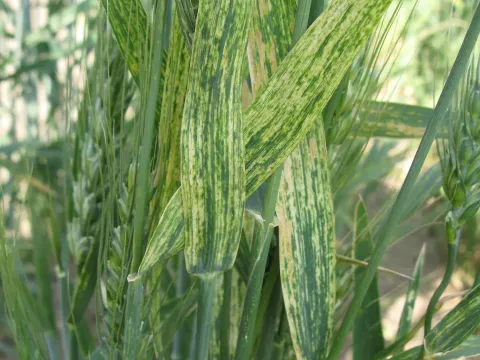
Key symptoms include leaf mosaic patterns, appearing as chlorotic spots, streaks, or stripes running parallel to the veins. Leaves may yellow and curl prematurely.
Infected plants exhibit significant growth retardation, showing signs of stunting and excessive tillering. Inhibition of root system development leads to decreased turgor and overall plant weakness.
During the heading phase, spike deformation occurs; ears often remain underdeveloped, sterile, or partially empty. Symptoms usually appear in patches corresponding to the distribution of soil-borne nematodes.
Early infection results in thinned crops and mass yellowing of young shoots. Leaf color can vary from light green to bright yellow depending on the severity of the viral development.
- Chlorotic spotting and striping of leaves.
- Growth retardation and pronounced stunting.
- Sterility or underdevelopment of spikes.
- Premature senescence and leaf tissue necrosis.
The development of the disease is closely correlated with the activity of nematode vectors. Optimal conditions include high soil moisture and moderate temperatures, which facilitate the movement of vectors in the rhizosphere.
Soil type plays a key role: on light, sandy, and loamy soils, nematodes move more easily, accelerating the virus spread. On heavy clay soils, infection patches are typically more contained.
Early sowing dates during a warm autumn increase the likelihood of young seedlings being infected. The virus accumulates faster in crops if the preceding plants supported populations of nematode vectors.
Poor crop rotation and the cultivation of susceptible durum wheat varieties on infected fields lead to a rapid increase in disease incidence. Lack of soil management against nematodes helps maintain the virus in the rotation.
Weather factors, such as a prolonged spring with significant rainfall, create a favorable environment for intense nematode feeding on roots, which accelerates plant inoculation with Qubevirus durum.
The damage caused by the virus results in a sharp decline in the thousand-kernel weight and overall yield, which can drop by 20-50% in affected areas. Grain quality, including vitreousness and protein content, is significantly degraded, which is critical for durum wheat.
Infected plants become more susceptible to secondary fungal and bacterial infections due to a weakened immune system, leading to additional losses from rots and necrosis.
Economic losses are driven not only by reduced harvest volume but also by costs associated with nematode control and the necessity of destroying infected crop patches. This reduces the profitability of durum wheat seed production.
The virus significantly impacts the ecological stability of the agro-ecosystem. Affected fields may require long-term removal from production for susceptible crops to sanitize the soil of vectors.
Due to the systemic nature of the infection, recovering yield in the current growing season after the appearance of primary symptoms is virtually impossible.
The primary control method is strict crop rotation using plants that are not hosts for the virus or the nematode vectors. Including non-susceptible crops helps reduce the density of nematode populations.
The use of resistant wheat varieties and hybrids is critical. Breeding for resistance remains the most environmentally friendly and effective method of crop protection.
Weed control is essential, as many weed species serve as viral reservoirs and food sources for nematodes during the off-season. Thorough field cleaning of stubble also contributes to reducing the infectious background.
Chemical control against nematode vectors using specialized nematicides can be effective but is limited by economic and environmental restrictions. Treatments should only be applied based on soil survey results.
Monitoring crop status and detecting patches at early stages allow for the isolation of infected areas, preventing the virus from spreading to the rest of the field via machinery and soil transport.