
Onion yellow dwarf virus
Potyvirus cepae
The causative agent of the disease is the Onion yellow dwarf virus (OYDV), which belongs to the Potyvirus genus. It consists of flexuous filamentous particles containing single-stranded RNA.
What the section contains
Onion yellow dwarf virus
The primary reservoir of infection in the field consists of perennial onion species, as well as infected sets and bulbs kept for planting. The virus persists in vegetative tissues throughout the dormant period.
The virus is transmitted by more than 50 species of aphids in a non-persistent manner. This means the aphid acquires the virus during brief feeding on an infected plant and immediately transmits it to a healthy one.
Transmission through seeds is rare or non-existent, making the use of infected plant material the primary source of initial outbreaks in new fields, often facilitated by local insect vectors.
The virus affects a wide range of Amaryllidaceae family crops, including all onion types (bulb, shallot, leek) and garlic. Cultural crops are the main hosts for the pathogen in agricultural environments.
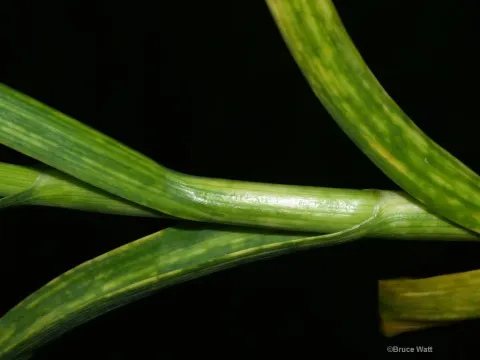
The most characteristic symptom is the appearance of yellow stripes on the onion leaves, usually running parallel to the leaf axis. Over time, these stripes become more intense and widespread.
Affected leaves often lose turgor, becoming wrinkled, crinkled, or twisted. In severe cases, the entire plant exhibits significant stunting and deformation compared to healthy specimens.
Bulbs produced by infected plants are typically smaller, distorted, and fail to mature properly. This reduction in quality makes the produce unsuitable for premium markets or long-term storage.
Symptoms are most visible during the early growth stages, particularly under warm conditions that favor rapid plant growth and aphid activity. Early infection leads to the most drastic yield reductions.
Diagnosing the disease visually can be difficult as symptoms may mimic nutrient deficiencies or other physiological disorders, necessitating laboratory testing for definitive identification.
The primary damage caused by the virus is a significant reduction in yield, which can range from 20% to over 50%. The resulting bulbs are often unmarketable due to their small size and poor shape.
Crop quality is severely compromised; affected bulbs lose firmness and storage potential, leading to high spoilage rates during post-harvest storage and transport, causing economic losses.
The virus weakens the plant's immune system, making it more susceptible to secondary fungal and bacterial infections. Often, infected crops suffer from complex disease pressure, complicating plant health management.
Using infected bulbs for propagation ensures that the infection persists in the next season, leading to cumulative yield losses and a complete loss of field profitability over several years.
In seed-producing fields, the disease is particularly hazardous as it hinders the production of high-quality seed, affecting the viability and vigor of the future crop.
The most effective strategy is the use of healthy, virus-free planting material. Growers must rigorously inspect and rogue out any sets or bulbs showing signs of deformation before planting.
Managing the aphid vector population is essential. Regular monitoring and the application of appropriate insecticides during the early stages of crop development help limit the spread of the virus.
Maintaining spatial isolation between new fields and old plantations or wild Allium species is a critical preventive measure to reduce the influx of the virus into the crop.
Effective weed control is necessary to eliminate alternative hosts that may harbor both the virus and the aphid vectors. Prompt removal of crop debris after harvest helps break the infection cycle.
Practicing good crop rotation, with a minimum 3 to 4-year interval between onion crops on the same site, is a standard agronomic practice to mitigate the accumulation of soil-borne risks and pests.