
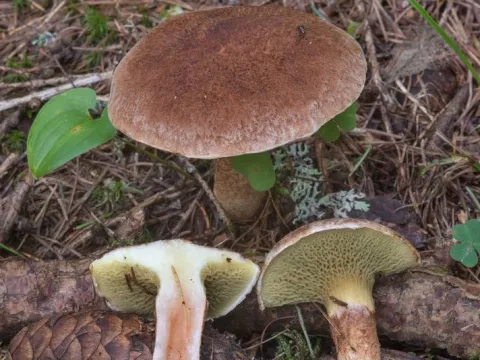
Hollow bolete
Suillus cavipes
The hollow bolete (Suillus cavipes) is not a plant disease or a pathogen. It is an edible mushroom from the Boletaceae family that exists in a strictly mutualistic mycorrhizal relationship with trees, specifically the larch (Larix).
What the section contains
Hollow bolete
It does not cause any plant diseases. On the contrary, it plays a beneficial role by enhancing the tree's ability to absorb water and essential nutrients from the soil through the formation of ectomycorrhizae.
The fungus functions as an essential partner in forest ecosystems, contributing to the health and vitality of the trees it colonizes. This symbiotic connection is mandatory for the fungus to fruit.
There are no known instances of this species harming vegetation. It is a biological partner that supports tree growth rather than infecting or damaging the plant tissue.
In forest management, the presence of these fungi is considered a sign of a healthy, functioning ecosystem where natural symbiotic processes are occurring correctly.
The primary diagnostic feature is the hollow stipe (stem) of the mushroom, which distinguishes it from other species. The cap is typically yellowish-brown or rusty-red with a velvety texture.
The underside of the cap contains a tubular hymenophore, which is yellowish and turns olive with age. It is often covered by a thin veil when the mushroom is young.
The stem often features remains of a ring or a distinct texture. These physical characteristics are used by mycologists and foragers to identify the species in the field.
It usually grows in small groups or solitary specimens near the base of larch trees, often hidden within moss or ground cover where moisture levels are maintained.
The appearance of fruiting bodies coincides with the vegetative season of the host tree, usually appearing from mid-summer through late autumn during humid weather conditions.
The growth and survival of the hollow bolete are entirely dependent on the presence of larch (Larix). It cannot complete its life cycle without this specific tree partner.
Ideal conditions include well-drained, slightly acidic soils common in coniferous and mixed forests. The fungus thrives in stable environmental settings with consistent moisture.
Optimal temperatures for fruiting range from 15 to 20 degrees Celsius. Excessive heat or prolonged drought can significantly inhibit the development of the fungal mycelium.
The underground mycelial network requires a balanced microflora and stable soil structure to maintain its mycorrhizal bond with the host tree's root system.
Any disruption to the soil layer, such as heavy machinery movement or chemical contamination, can destroy the fragile symbiotic connection required for the fungus to thrive.
The hollow bolete is completely harmless to agriculture and forestry. It is not an agent of decay, nor does it interfere with tree health or productivity.
Control measures are unnecessary and counterproductive. Because the species is a symbiotic partner, removing or attempting to control it would be detrimental to the health of the larch trees.
- Promotes water uptake for trees.
- Enhances mineral nutrient availability.
- Supports long-term soil structure.
- Provides food for local wildlife and humans.
- Maintains ecological stability in larch stands.
As a non-pathogenic species, it requires no protective measures for crops. Its presence should be encouraged as a marker of a thriving, symbiotic forest environment.
The economic value of this mushroom is found in recreational foraging and its contribution to the forest ecosystem, making it a highly appreciated species by mushroom enthusiasts.