
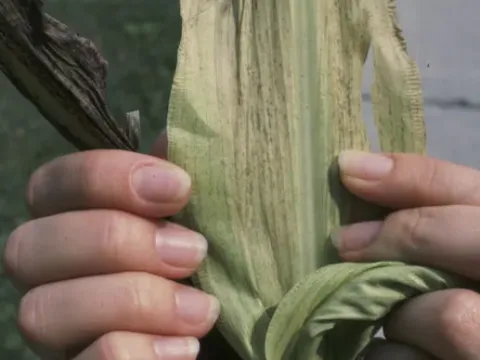
Sorghum downy mildew
Sclersopora sorghi
The causative agent of the disease is the oomycete Sclerospora sorghi, an obligate parasite. This pathogen can persist in the soil as oospores for several years, making it a persistent threat to agricultural fields.
What the section contains
Sorghum downy mildew
Infection spreads through contaminated soil debris and infected seeds, which serve as the primary source of inoculum for new plantings.
Oospores germinate to form zoosporangia, which are disseminated by wind or rain splashes onto healthy plant tissue when environmental conditions are suitable.
The mycelium of this organism grows systemically within the plant tissues, colonizing the vascular system of both sorghum and corn.
During the growing season, the pathogen produces secondary spores (conidia) that allow for rapid secondary infections across the field.
The initial symptoms appear as chlorotic stripes on young leaves, which eventually become more pronounced and turn yellowish over time.
Under high humidity, a white or gray downy growth, consisting of conidiophores and conidia, becomes visible on the underside of the affected leaves.
Systemically infected plants are often stunted, appear bushy due to excessive tiller development, and fail to reach their full potential height.
As the disease progresses, leaf tissues undergo necrosis and premature drying, significantly reducing the photosynthetic capacity of the crop.
In later stages, the inflorescences (panicles) are often deformed, becoming sterile or failing to develop entirely, which severely impacts grain yield.
The development of sorghum downy mildew is favored by temperatures between 20 and 25 degrees Celsius, which are optimal for oospore germination.
High relative humidity, persistent fog, and free moisture on leaf surfaces are critical factors that promote active spore production and field spread.
Poorly drained soils or areas prone to waterlogging significantly increase the risk of initial infection in sorghum and corn plantings.
Delayed planting dates, coinciding with warm soil and high humidity, often result in higher infection rates in young seedlings.
Cultivating susceptible hybrids in fields with a history of the pathogen ensures rapid disease spread under favorable weather conditions.
The primary damage is caused by the systemic nature of the infection, leading to substantial yield losses in both grain and forage production.
Infected plants frequently fail to produce viable heads or ears, resulting in total crop loss in heavily infested areas of the field.
The disease affects both sorghum and corn, posing a significant risk to rotation systems that involve these two related host crops.
Physiological disruption caused by the pathogen degrades the nutritional quality of the forage, making it less valuable for livestock feed.
In cases of severe early-season infection, total crop failure may occur, necessitating reseeding or abandonment of the affected field.
The most effective strategy for managing sorghum downy mildew is the use of resistant hybrids, which provides the best economic return.
Implementing a crop rotation strategy with a 3-4 year break from susceptible hosts helps to reduce the inoculum levels of oospores in the soil.
Proper management of crop residues, including deep incorporation into the soil, helps to eliminate the survival structures of the pathogen.
Treatment of seeds with systemic fungicide dressings is a crucial practice to protect seedlings during the highly susceptible emergence stage.
- Use of crop rotation.
- Planting resistant hybrids.
- Seed treatment with fungicides.
- Weed management.
- Soil drainage improvements.