
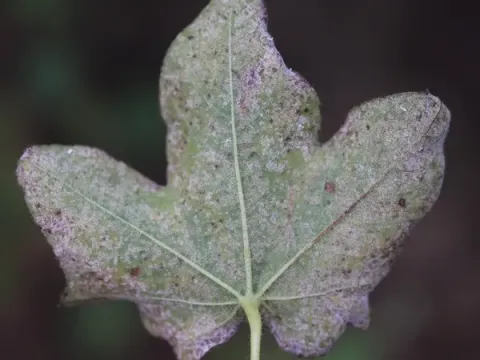
Areolate mildew of cotton
Ramulariopsis gossypii
The causative agent of this disease is the fungus Ramulariopsis gossypii (synonym: Ramularia areola). It is a specialized pathogen that infects exclusively cotton plants.
What the section contains
Areolate mildew of cotton
The fungus is characterized by the formation of white, powdery lesions on the underside of the leaves, which consist of conidiophores and abundant conidia.
The pathogen primarily survives in infected plant debris left in the field after harvest, serving as the main source of inoculum for the subsequent season.
Transmission can also occur through contaminated seeds. Once introduced into a field, the disease spreads rapidly via airborne conidia during periods of high humidity.
This fungus is highly sensitive to environmental changes, particularly moisture levels, which trigger the release and dispersal of spores throughout the crop canopy.
The disease is commonly known as areolate mildew. The primary symptoms appear on the lower leaves as small, chlorotic, angular spots confined by the leaf veins.
As the spots mature, they take on a pale green or yellowish color, often showing a characteristic mosaic pattern across the leaf surface.
A distinctive white, fuzzy fungal growth develops in the center of these spots on the undersurface of the leaf, which is a key diagnostic feature of the disease.
As the infection progresses, the spots may turn brown and necrotic, causing the leaf tissue to become brittle and eventually fall off the plant.
In cases of severe infection, extensive defoliation occurs, which compromises the plant's ability to maintain optimal growth and fiber development.
Areolate mildew development is favored by warm, humid weather. The optimal temperature range for the pathogen's growth is between 20°C and 25°C.
Periods of frequent rainfall, heavy dew, or high relative humidity are essential for the germination of conidia and the rapid spread of the disease within the crop.
Dense crop stands that restrict air movement and trap humidity inside the foliage create an ideal microclimate for the fungus to thrive.
Poorly drained soils or excessive irrigation can contribute to high moisture levels, which exacerbate the disease pressure in cotton fields.
Environmental conditions that stress the plant, such as nutrient deficiencies, can also increase the susceptibility of cotton to fungal infections.
The primary economic impact of this disease is the premature shedding of leaves, which reduces the plant's photosynthetic capacity and total energy production.
This reduction leads to a decrease in the number of bolls, lower boll weight, and reduced fiber quality, including decreased fiber length and strength.
Heavy infections can result in significant yield losses, as the plant cannot adequately support the development of mature lint and seeds.
Secondary infections by other pathogens are more likely to occur on plants already weakened by areolate mildew, further damaging the crop.
Reduced seed quality and oil content are additional negative consequences, impacting the profitability of the harvest for both fiber and seed industries.
Crop rotation is the most effective cultural control method, as it prevents the buildup of the pathogen in the soil and on crop residues.
Deep plowing after harvest is essential to bury crop debris and promote its decomposition, thereby reducing the amount of inoculum for the next cycle.
The use of disease-free, high-quality seeds treated with appropriate fungicides is vital for preventing the introduction of the pathogen into new areas.
Foliar application of fungicides can be effective if implemented early, especially during the peak periods of infection when weather conditions favor the disease.
- Maintain proper plant spacing to improve airflow.
- Implement integrated weed management to reduce humidity.
- Monitor fields regularly during the flowering stage.
- Select resistant cotton cultivars where available.