
Description
Symptoms
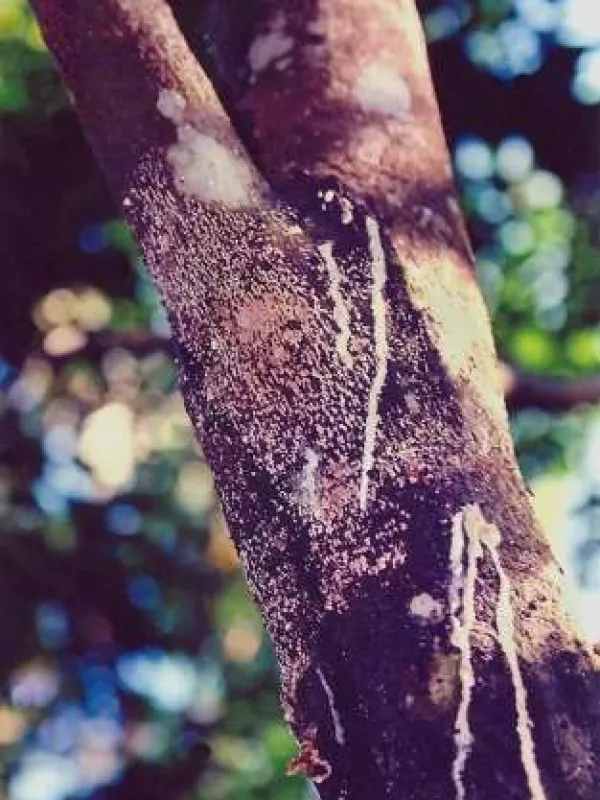
The first symptom is usually the appearance of fine, silvery, web-like mycelium threads on the surface of branches. As the disease progresses, this mycelium thickens and develops a distinct pink or salmon-colored crust.
Bark cracking is a major indicator of advanced infection. The tissue beneath the crust dries out and decays, leading to deep longitudinal fissures. Eventually, the bark may peel away from the wood, exposing the decaying trunk or branch.
Affected trees often exhibit sudden wilting of leaves followed by defoliation, particularly in the canopy sections above the infection point. As the branch dries out completely, the foliage turns brown and remains attached or falls prematurely.
In humid conditions, small, elevated pustules develop along the cracks. These are the fruiting bodies of the fungus, producing masses of spores that facilitate the rapid spread of the pathogen to neighboring branches or adjacent trees.
- Silvery web-like mycelium on bark.
- Salmon-pink crusty growth.
- Deep longitudinal cracks in the bark.
- Sudden wilting and death of leaves.
- Total desiccation of branches.
Pathogen
The causal agent of Pink Disease is the basidiomycete fungus Erythricium salmonicolor (formerly known as Corticium salmonicolor). This pathogen is widely distributed in tropical and subtropical regions where it affects a broad range of woody plants.
The fungus is known for its polymorphic nature, manifesting in different stages including the cobweb stage, the pustule stage, and the crust stage. Each phase allows the fungus to adapt to varying moisture and temperature conditions in the orchard.
Transmission occurs primarily through basidiospores carried by wind and splashing rainwater. These spores land on the bark of susceptible hosts and germinate, allowing the mycelium to penetrate through existing cracks or wounds in the tree's surface.
Once established, the pathogen colonizes the bark and cortical tissues, disrupting the flow of water and nutrients within the branches. This results in localized necrosis and the eventual death of the affected plant parts.
The fungus is named for the characteristic salmon-pink to light orange mycelial growth that appears on the bark. This visual identifier is critical for early field detection and effective integrated pest management (IPM) strategies.
Conditions for development
High relative humidity is the most critical factor for the development of Pink Disease. The fungus thrives in climates with prolonged rainy seasons, where moisture persists on tree surfaces for extended periods, enabling spore germination.
The temperature range optimal for the growth of Erythricium salmonicolor is typically between 20°C and 30°C. These conditions are standard in many tropical regions, making year-round management of the pathogen necessary.
Poor orchard ventilation significantly increases disease incidence. Trees planted at high density with intertwined branches create a microclimate with reduced airflow, which prevents bark from drying out after rainfall and fosters fungal development.
Injuries to the bark serve as primary entry points for the infection. Sunscald, insect damage, hail, or wounds inflicted by gardening tools provide easy access for the mycelium to bypass the tree's natural physical defenses.
Weakened host plants are more susceptible to invasion. Nutrient deficiencies, particularly an imbalance in potassium or nitrogen, can render a tree less resilient to infection compared to well-nourished, vigorous specimens.
Why it matters
Pink Disease causes substantial damage to the agricultural industry, specifically for crops like citrus, coffee, cocoa, and mango. It leads to significant yield losses due to the death of fruit-bearing branches and overall tree vigor decline.
Structural damage is a major concern as the fungus rots the inner wood. Infected branches become brittle and are prone to breaking under heavy fruit loads or high winds, causing direct loss of production and potential structural failure of the tree.
The management costs associated with the disease are high. Growers must invest in regular pruning, chemical control, and constant monitoring, which increases the overall cost of production and decreases the profitability of the plantation.
Failure to control the disease can result in the complete death of productive trees, necessitating costly replanting efforts. Large gaps in a plantation reduce land-use efficiency and require several years of investment before returning to full productivity.
Due to the cryptic nature of the early stages, the disease often goes unnoticed until branch dieback occurs. By this time, the pathogen may have already spread to other parts of the canopy, making complete eradication difficult.
Protection
The most effective management strategy is the rigorous removal of all infected branches. Pruning must be done well below the visibly diseased area, and all tools should be sanitized with alcohol or bleach after every cut to prevent cross-contamination.
Preventive application of copper-based fungicides is standard practice. These chemicals should be applied to the main trunks and primary branches before the start of the rainy season to create a protective barrier against basidiospore germination.
Proper orchard management, including regular pruning for canopy thinning, is essential. Enhancing airflow and light penetration allows the bark to dry faster after rain, making the environment unfavorable for fungal growth.
Implementing a balanced fertilization program helps maintain tree health and resilience. A well-nourished tree can better defend itself against pathogen colonization compared to a nutrient-deficient or stressed tree.
Integrated pest management also includes controlling insects that cause bark damage. Protecting the physical integrity of the bark is the best way to prevent the pathogen from establishing itself within the woody tissues of the host crop.
Pathogens and affected parts
Affects crops · 5
Discussion
No discussions yet — be the first.