
Phyllachora nitens
Phyllachora nitens
The causal agent of this disease is the ascomycete fungus Phyllachora nitens, which belongs to the order Phyllachorales. It is a specialized pathogen that primarily targets various grass species.
What the section contains
Phyllachora nitens
The fungus is an obligate parasite, living within the host plant tissues. A key feature of its biology is the formation of black, glossy structures known as stromata on the leaves.
These stromata serve as protective chambers where the fungus develops its reproductive structures. Once mature, the fungus releases ascospores into the environment to initiate new infections.
Dissemination occurs primarily through wind and water splashes. Spores are carried over short or long distances, allowing the disease to spread rapidly throughout a crop field.
The pathogen can overwinter on crop residues left on the field. In the following spring, when environmental conditions become suitable, these residues serve as the primary source of inoculum.
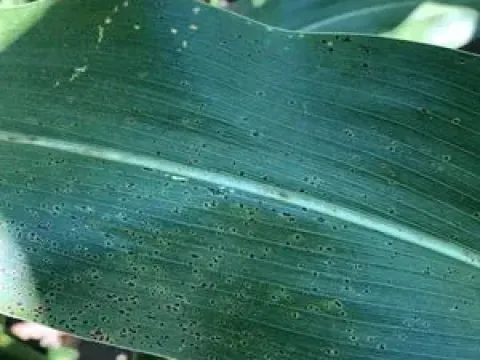
The disease is characterized by the appearance of small, circular spots on leaf blades. These spots quickly transition into black, shiny, raised lesions that look like drops of black wax.
The glossy, mirror-like surface of these lesions is a definitive diagnostic symptom for Phyllachora nitens. They are typically found on both the upper and lower surfaces of leaves.
The tissue surrounding the spots often becomes chlorotic, leading to a yellowing of the leaf. As the infection progresses, large parts of the leaf tissue may wither and die.
Severe infections can cause early senescence of the foliage. This often results in leaf drop, which significantly compromises the health and vitality of the affected plant.
Signs are usually most visible during the mid-to-late growth stages of the plant, when the fungus completes its reproductive cycle and forms dense clusters of stromata.
Development of the disease is heavily dependent on moisture. High humidity and persistent dew provide the necessary surface moisture for ascospore germination and penetration.
The fungus thrives within a temperature range of 20 to 25 degrees Celsius. These conditions are optimal for both mycelial growth and the subsequent development of reproductive stromata.
Poor field ventilation, often caused by high planting density, creates an ideal microclimate for the disease. Dense foliage slows down evaporation, keeping leaves wet for longer periods.
Farming practices that leave large amounts of plant debris on the soil surface contribute to the build-up of the pathogen population from one season to the next.
Plants under stress, whether from nutrient deficiency or drought, tend to be more susceptible to infection by this fungus compared to vigorous, well-nourished plants.
The primary harm caused by Phyllachora nitens is the reduction of functional leaf area. This directly hinders the plant's ability to perform photosynthesis efficiently.
Reduced photosynthetic capacity leads to stunted plant growth and lower biomass production. This results in significant yield losses in both grain crops and forage grasses.
In addition to yield reduction, the quality of the harvested produce is often compromised. Forage crops may lose their nutritional value and palatability for livestock.
The infection can weaken the plant's overall system, making it more susceptible to secondary infections by other opportunistic pathogens or pests.
Farmers face financial losses not only from reduced production but also from the increased costs associated with implementing necessary control and protection measures.
Crop rotation is the most effective cultural practice for managing this disease. Avoiding the planting of susceptible grasses in the same field sequentially breaks the infection cycle.
Deep plowing and proper burial of crop residues are crucial. By placing the infected plant material deep into the soil, the survival of the fungus is significantly limited.
Using resistant or tolerant crop varieties is a primary strategy for long-term disease management. Genetic resistance helps keep the disease pressure at a manageable level.
When the disease reaches an economic threshold, the application of appropriate systemic fungicides can help protect the crop and suppress the spread of the fungus.
- Elimination of wild grass weeds that act as alternative hosts.
- Proper management of nitrogen levels to avoid overly lush, disease-prone growth.
- Maintaining optimal plant spacing to promote airflow and leaf drying.
- Sourcing healthy, certified seeds to prevent early-stage infection.