
Pertusaria
Pertusariaceae
Pertusaria is a genus of crustose lichens that often appears on the bark of fruit and forest trees, frequently confused with pathogenic diseases.
What the section contains
Pertusaria
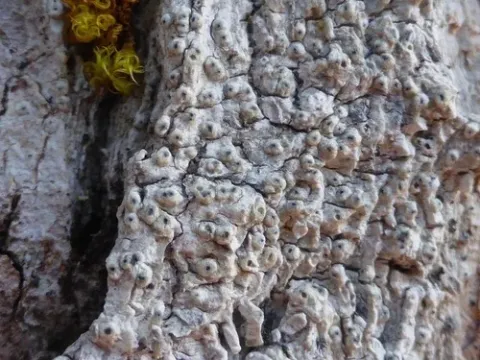
The colonies appear as whitish, grayish, or yellowish patches that adhere tightly to the bark surface, gradually spreading in circular patterns.
A distinctive diagnostic feature is the presence of small bumps or pits known as apothecia, which are embedded within the thallus.
Unlike parasitic fungi, these lichens do not penetrate deep into the woody tissue, yet they change the visual texture and color of the bark significantly.
The growth is typically very slow, covering branches over several years and becoming more prominent in neglected or unpruned trees.
Pertusariaceae is a family of lichenized fungi, which are biological symbioses consisting of a fungal partner and a photobiont (algae).
It is important to classify them correctly as epiphytes rather than plant pathogens, as they do not feed on the internal juices of the tree.
The fungus provides structural support and moisture absorption, while the algae supply necessary nutrients via photosynthesis.
Reproduction occurs through spores released into the air, which settle on bark and germinate under specific environmental conditions.
They act as colonizers of the surface, establishing a long-term relationship where the tree provides only the mechanical substrate for survival.
High humidity and consistent moisture are the most critical factors for the survival and colonization of Pertusaria lichens.
Dense, unpruned canopies that limit airflow and trap humidity create the perfect microclimate for these organisms to thrive.
Trees with rough, aging, or cracked bark are more susceptible to colonization as these surfaces retain water better than smooth young bark.
Pertusaria species are highly sensitive to air pollution; therefore, their abundance often reflects a clean, high-quality environment.
Lack of direct sunlight in the lower parts of the tree allows for sustained dampness, promoting faster expansion of lichen mats.
The primary concern is that dense lichen mats provide a protected habitat for harmful insect pests, such as scale insects and spider mites, to overwinter.
The moisture retained by the lichen can lead to localized temperature drops, potentially causing bark cracking during extreme winter weather.
By covering the bark, the lichen may restrict the normal gas exchange through lenticels, causing slight stress to the tree's metabolic functions.
Lichen coverage can mask the symptoms of underlying infections, making it harder to detect true fungal pathogens in the early stages.
While not lethal on its own, chronic heavy coverage contributes to overall tree decline in low-vigor orchards that lack consistent care.
Mechanical removal is the most effective approach; use scrapers or stiff brushes to clear the bark during humid weather to prevent damage.
Improving air circulation through systematic pruning is essential to eliminate the moist conditions that favor lichen development.
Applying a traditional lime wash to the trunks creates an alkaline environment that prevents lichen spores from successfully establishing.
For extensive cases, spraying the bark with a solution of ferrous sulfate (iron sulfate) can kill the lichen without harming the dormant tree.
- Regular thinning and pruning of the tree crown.
- Manual bark cleaning with mechanical scrapers.
- Application of white lime wash on trunks.
- Copper or iron sulfate treatment.