
Pertusaria corallina
Pertusaria corallina
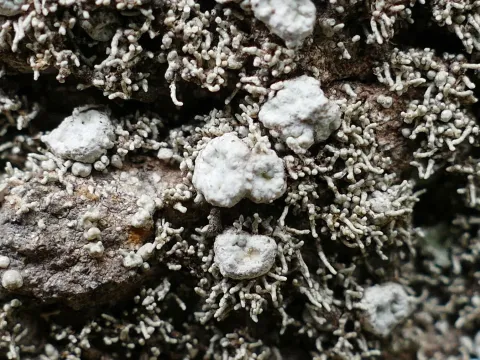
Pertusaria corallina is a crustose lichen known for its distinctive coral-like, granular, and white or greyish appearance. It commonly colonizes the bark of trees and rocky surfaces.
What the section contains
Pertusaria corallina
The growth appears as dense patches or crusts that are firmly attached to the substrate. As the colony matures, these patches can merge to cover large areas of the trunk or branches.
It does not cause visible lesions, necrosis, or structural decay in the bark, unlike true pathogenic fungi. The surface underneath remains intact, though it may hold more moisture.
This lichen is most frequently observed on older, slow-growing trees. Its presence serves as a visual indicator of the tree's age and the long-term environmental stability of the area.
Unlike parasitic infections, the presence of Pertusaria does not usually alert a grower to an immediate crisis, but rather signals the need for better orchard maintenance.
Pertusaria corallina is not a plant pathogen or a disease agent. It is a symbiotic organism consisting of a fungus and an alga living together in a mutualistic relationship.
This organism is classified as an epiphyte. It utilizes the tree bark purely as a physical anchor and does not derive nutrients or moisture directly from the tree's living tissues.
The tree remains the host only in a passive sense. The lichen produces its own carbohydrates through the photosynthetic activity of the algae, while the fungus provides structural protection.
While often listed in general gardening manuals alongside "bark diseases," this is scientifically incorrect. It does not penetrate the cambium or infect the vascular system of the plant.
Growers should distinguish between lichen colonization and actual fungal pathogens like Nectria or Venturia, as their impact on tree health is vastly different.
The colonization of Pertusaria is favored by high relative humidity and reduced air circulation. Environments with stagnant air are the most prone to lichen development.
Poorly pruned trees with dense canopies create a sheltered, humid microclimate that is optimal for lichen spores to land and germinate on the bark surface.
Older trees with rough, fissured bark provide the best surface for attachment, allowing the lichen to establish itself in the crevices where organic debris often accumulates.
Insufficient light exposure also promotes lichen growth. Trees located in shaded, damp areas of an orchard or garden are much more likely to show signs of lichen colonization.
Prolonged wet seasons and cool temperatures contribute to the rapid expansion of Pertusaria, as it thrives under conditions where the bark surface dries out slowly.
Pertusaria corallina does not cause direct harm to the tree's metabolic processes or its ability to transport nutrients. However, it can harbor indirect risks for the orchard.
The layer of lichen can act as a refuge for various insect pests, including scale insects, mites, and their eggs, protecting them from predators and direct contact with insecticides.
Constant moisture retention caused by lichen crusts can eventually lead to bark softening, potentially creating an entry point for secondary bacterial or fungal opportunistic infections.
Dense lichen coverage may hinder the bark's gas exchange, which is essential for the overall physiological balance of the tree, especially during the active spring growth phase.
While often viewed as purely aesthetic damage, excessive lichen growth on young trees is a sign of poor vitality and environmental stress that should be addressed.
Effective control of Pertusaria involves improving orchard sanitation and tree health. Focus on removing the conditions that allow the lichen to thrive.
Mechanical removal is a standard practice: using a stiff brush or a specialized tool to scrape off dead bark and lichen layers during the dormant season helps maintain tree hygiene.
- Pruning branches to improve light penetration and airflow within the canopy.
- Applying whitewash to the trunk to sanitize and reflect excess sunlight.
- Ensuring proper orchard drainage to lower ambient humidity levels.
- Applying copper-based fungicides to inhibit spore germination during dormant stages.
- Promoting vigorous growth through balanced fertilization and adequate hydration.
Dormant sprays, such as lime sulfur or copper mixtures, are highly effective at reducing lichen populations on tree trunks without causing phytotoxicity to the host tree.
Ultimately, a healthy, actively growing tree is the best defense against lichen colonization, as the bark surface of a vigorous tree is generally less conducive to such growth.